Music ·
Stylophone On-The-Fly: a £149 sequencer for playing live, no screens or menus
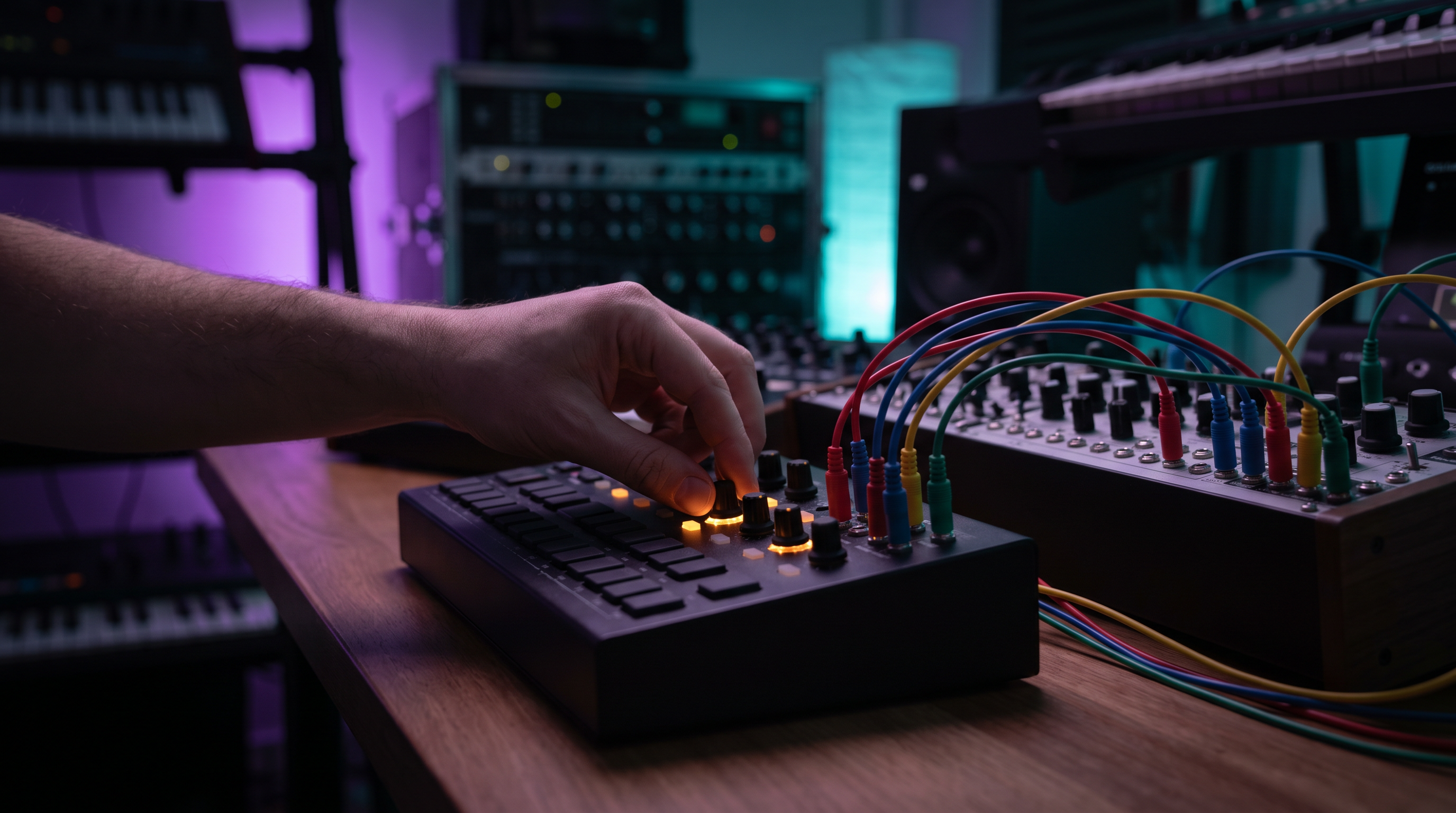
Dubreq, the British company behind Stylophone, is now selling the On-The-Fly (OTF), a step sequencer you play live: no screen, no menus, and no need to stop the music to change the pattern. It costs £149 in the official store and, according to Synth Anatomy, $199 USD or 169 euros from distributors. It runs on AA batteries, with a power adapter, or screwed into a Eurorack rack, and it speaks CV, Gate, MIDI and Sync. If you play live with hardware, or you want to drop an acid bassline into your set without opening the laptop, it's one of those cheap sequencers worth keeping on your radar.
What it is and where it comes from
Stylophone presents the OTF as the new piece in its Pro range and in a new series it calls Music Lab. Its battle cry is that it's a sequencer "made to be played, not just programmed." MusicRadar titled its piece with the brand's promise: no screens, no menus, nothing in the way.
The device was shown at NAMM 2026, in January, with no price or date. According to Synth Anatomy, Dubreq put ten months of development into it and it's now on sale. It's a sibling of the CPM (Compact Portable Modular) family, the one with the DS-2 and DF-8 modules that can also be used on a desk or mounted in Eurorack.
How it works: 8 steps that become 64
The core idea is in the official manual. You program just 8 steps, split into two patterns of four: A (steps 1 to 4) and B (steps 5 to 8). Each step has a knob that sets its pitch or, with a button, its length: from 10% to 90% of the step.
Then the Pattern Chain knob comes in, with eight combinations. The manual gives AAAB as an example: A three times, then B. If the letter appears reversed on the panel, that pattern plays backwards. The Chain Length switch stretches the count: at 16 it plays only the chosen combination, at 32 it adds the next knob position, and at 64 it adds the next three. And another switch changes the direction of the whole chain: forward, reverse, or back and forth (bounce).
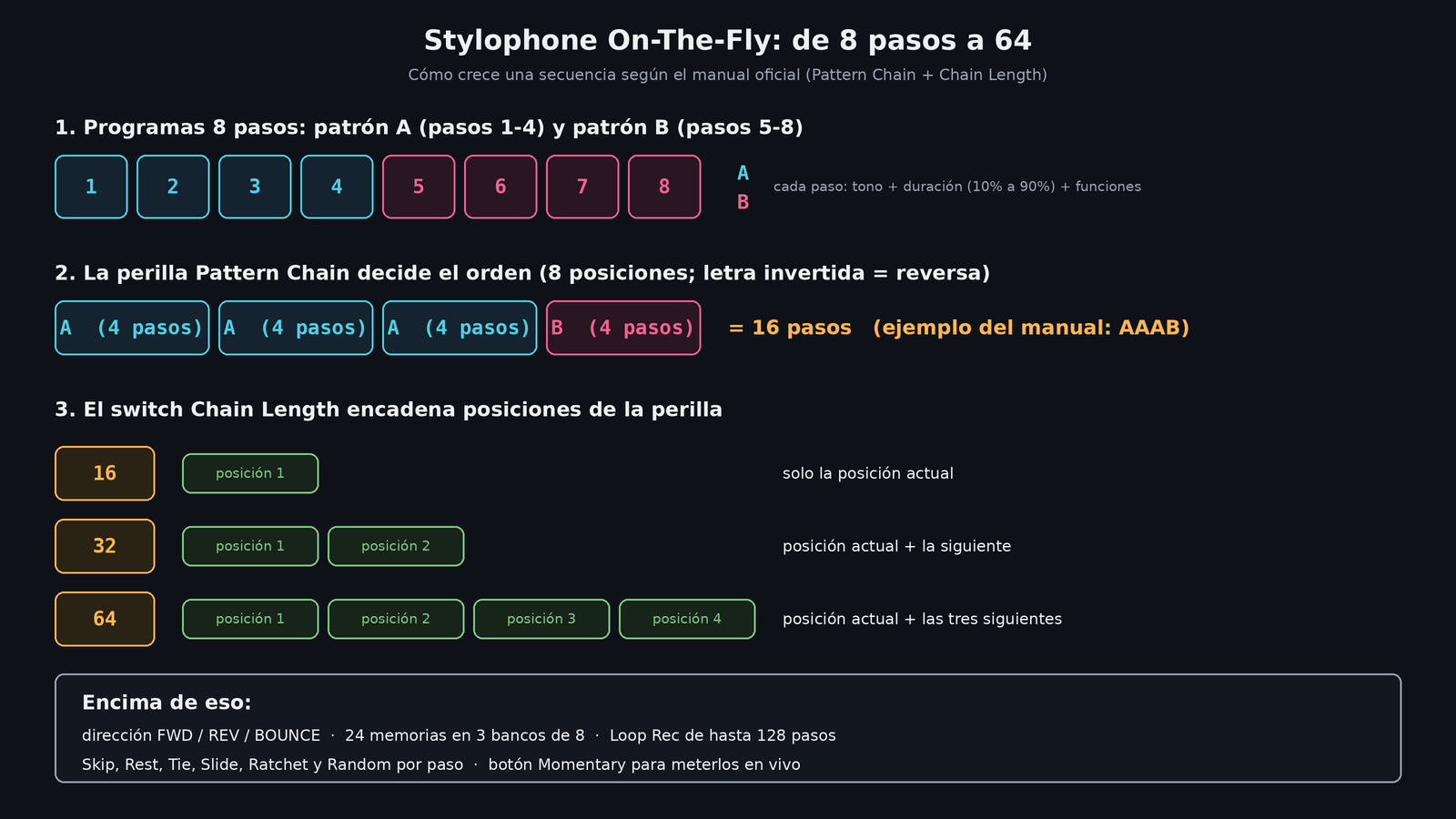
On top of that you get six functions per step: Skip, Rest, Tie, Slide, Ratchet and Random. You can leave them recorded in the pattern or throw them in by hand with the Momentary button, which according to the manual can trigger Tie+Slide, Ratchet or a second Random mode while the sequence runs.
To keep it from going out of tune, the Scale knob locks the notes to a scale: chromatic, major, minor, blues, Byzantine, Raga Desh, Akebono and others, or continuous mode if you want free voltages. Transposition goes in jumps of −7, −5, −2, 0, +2, +5 and +7 semitones, plus one octave up, and it's controlled by knob, CV or MIDI notes.
Memories, looper and groove
- 24 pattern memories, in three banks of eight, loaded in real time.
- Loop Rec: records what you do to the pattern while it plays and repeats it in a loop. Up to 128 steps, with 24 loop memories.
- Pattern Link: alternates two memories to build sequences of up to 16 steps.
- Groove: tempo from 50 to 250 BPM, swing from 50% to 75%, lead/lag against the external clock, and note and gate length.
One detail: Synth Anatomy mentions a looper of up to 1,024 steps. The manual and the official page say 128, so I'm going with what the manufacturer says.
Connections and power
- Per-step gate outputs: eight, one per step, plus a summed gate output. For triggering drums or envelopes separately, that's really nice.
- Pitch CV from −3 to 7 V (v/oct) and gate selectable between 5 and 10 V.
- MIDI in and out: receives and sends clock, start and stop. Incoming notes transpose the pattern. Heads up: the manual points out that slides are not sent over MIDI.
- Sync in and out at 1, 2 or 4 PPQN, plus Play/Stop and Reset inputs.
- Power: non-rechargeable AA batteries, a 12 V 200 mA adapter, or the Eurorack power connector (+12 V, 150 mA). Rack-mounted it takes up 42 HP.
- Size: 24.5 × 13.2 × 4.2 cm, metal and plastic. Comes with four patch cables.
Several units can be chained in sync to build a multi-sequencer system, according to the official page.
My take
I haven't tested it: all of this comes from the official page, the manual and Synth Anatomy's coverage.
That said, the OTF is aimed at a clear gap. Synth Anatomy compares it to the Korg SQ-1, and the comparison makes sense: it's a cheap, hands-on sequencer where each knob does just one thing. What it adds is the performance side. With the A/B chain, the per-step functions and the Momentary button, changing the phrase is a gesture, not an edit. For anyone playing techno or acid live, Slide, Tie and Ratchet are exactly the vocabulary of a 303-style line, and MIDI clock lets you hang it off the drum machine or the DAW without fighting the tempo.
The limits are in plain sight too. It's monophonic in pitch, since it has a single pitch CV output, and eight base steps ask you to think in short phrases. The plastic enclosure has already sparked debate in the Synth Anatomy comments. And at £149 it competes head-on with sequencers that have screens and store more. Dubreq's bet is that, live, immediacy is worth more than memory.