Music ·
Behringer promises an open-source $200 SP-1200 and unveils the Polyeight, RD-765 and Ignite
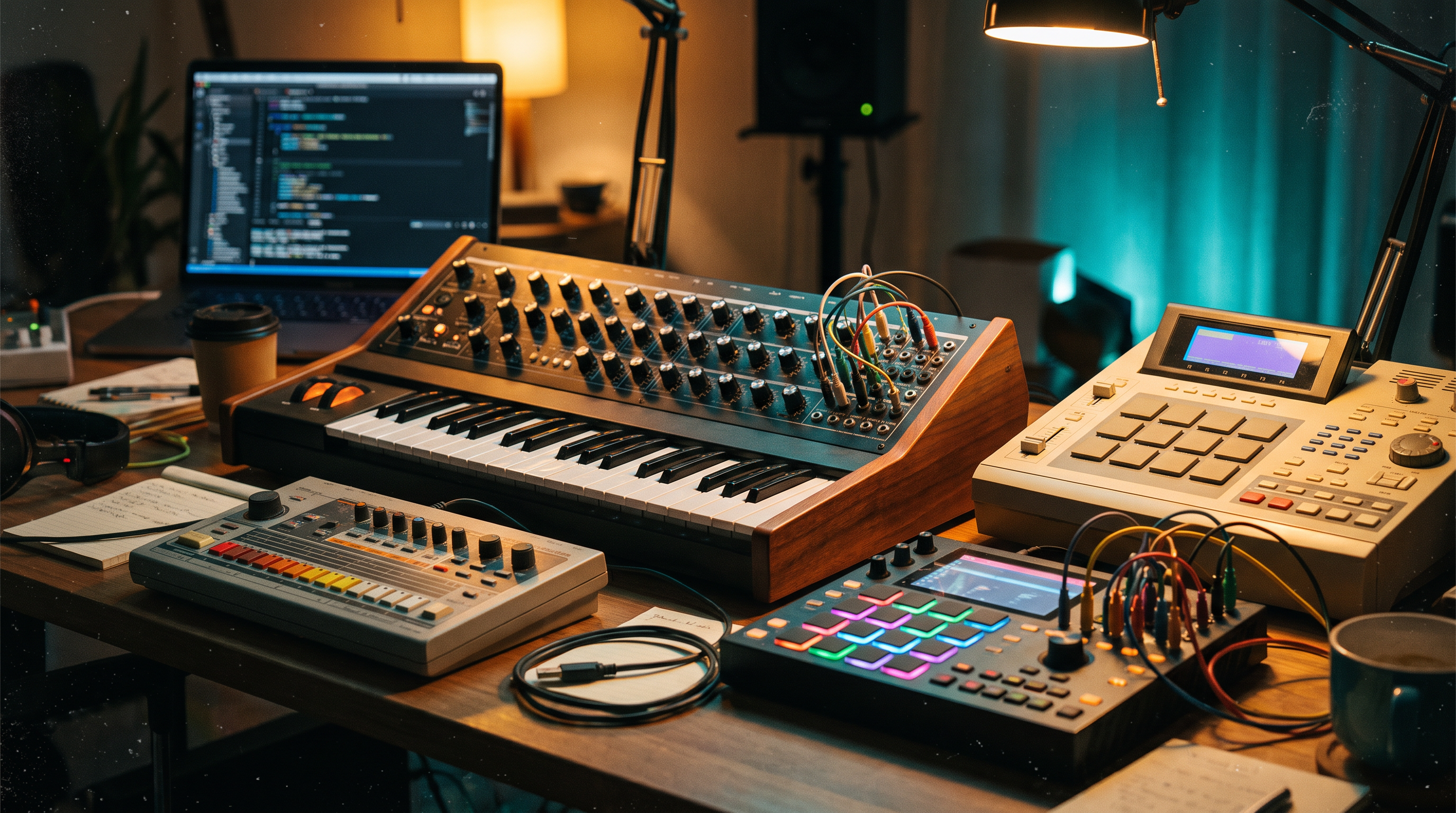
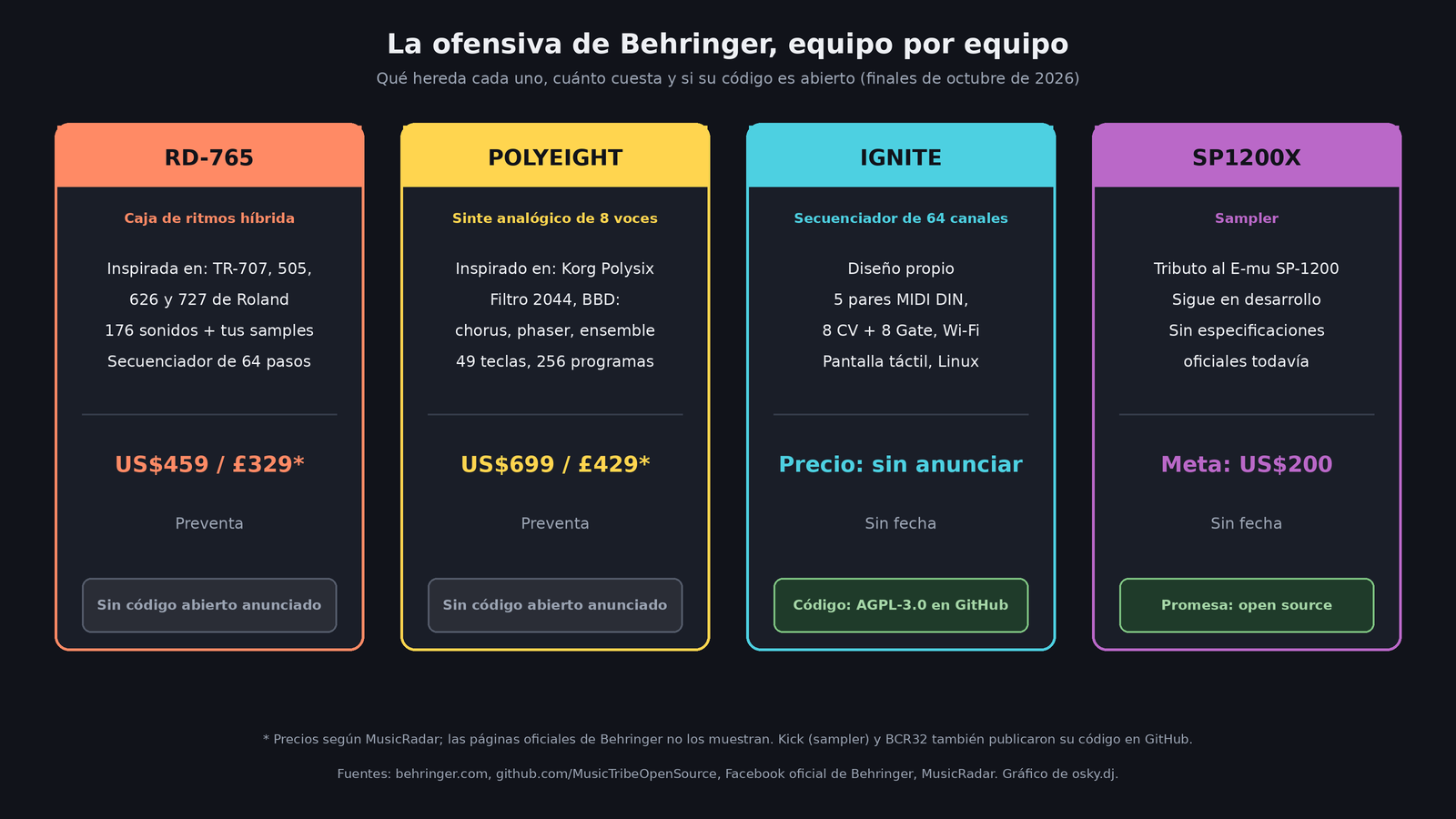
Behringer closed out October with a barrage of announcements: a sampler paying tribute to the E-mu SP-1200 with a target price of $200 and a promise that it will be open source, the Polyeight (an eight-voice analog synth inspired by the Korg Polysix), the RD-765 (a hybrid drum machine that blends the DNA of four eighties Roland machines) and the Ignite, a 64-channel sequencer whose code is already on GitHub. If you produce, play live or build a hardware setup, the interesting part isn't just the usual cheap clones: Behringer is seriously pushing the idea that the firmware of its gear can be modified by the community.
SP1200X: the $200 tribute that doesn't exist yet
In a post on its official Facebook page, Behringer introduced the SP1200X as "our tribute to the legendary E-mu SP-1200." The company says it is still developing it, that it is "pushing hard" to release it soon, that it is aiming for a price of "just $200" and that it will be open source. It published no specs, no date and no product page.
According to MusicRadar, the project has been in development since 2019, Behringer didn't publicly acknowledge it until early 2025 (when it asked its users for feature ideas) and, judging by the images, the unit would have a larger color screen, stereo sampling inputs and USB. MusicRadar also recalls what made the original famous: its gritty 12-bit sound at 26.04 kHz.
My take: the question the comments on the post itself keep repeating is the right one. An SP-1200 is worth it for how it sounds, not how it looks. With a $200 target and zero specs, right now this is a promise, not a product. If the code is truly open, at least the community will be able to tweak whatever Behringer gets wrong.
Polyeight: the Polysix with two extra voices
The official page describes the Polyeight as a programmable eight-voice analog synthesizer that reproduces the discrete VCOs and the 2044 lowpass filter of the Korg Polysix. Each voice has sawtooth, square and pulse-width waves, with unison, double and poly modes. The BBD effects (chorus, phaser and ensemble) sit inside the signal path.
What it adds on top of the original idea, according to Behringer:
- 49-key semi-weighted keyboard with velocity sensitivity and channel aftertouch.
- Sub-oscillator (one or two octaves down), an MS-20-inspired noise generator, a multi-wave LFO and an eight-slot modulation matrix.
- Arpeggiator, chord memory, polyphonic portamento and 256 user programs.
- LCD screen with encoder, CV and pedal inputs, and full MIDI.
One detail: MusicRadar wrote that it has polyphonic aftertouch, but Behringer's page says channel aftertouch. Until the manual comes out, I'm going with what the manufacturer says. MusicRadar reports a price of $699 (£429) and that it is already available for pre-order.
RD-765: four Rolands in one box
The RD-765 doesn't clone just one machine. MusicRadar explains that its sounds are based on Roland's TR-707, TR-505, TR-626 and TR-727. The official spec sheet confirms what matters in the studio:
- 176 drum sounds and the option to record your own samples and assign them to a channel, with tuning up or down 24 semitones.
- Wave Designer attack control to add punch to the transient, a two-mode analog filter (lowpass or highpass) assignable to individual voices and a bitcrusher.
- Sequencer with up to 64 steps, swing from 25 to 75, per-voice probability and recording of filter movements within the pattern.
- MIDI and USB.
MusicRadar adds individual outputs per voice, trigger outputs, analog sync and a price of $459 (£329), also in pre-order.
Ignite and the bet on open source
The most interesting move isn't a clone. Ignite is a 64-channel sequencer with a touchscreen, 16 RGB pads with their own encoder, eight assignable knobs, five pairs of MIDI DIN, USB MIDI (also as a host for up to five devices), 8 CV and 8 Gate outputs, Wi-Fi and an internal General MIDI sound engine. Its patterns go up to 16 bars of 16 steps and scenes up to 200 bars.
Behringer published its code in the repository MusicTribeOpenSource/0716-AAF: the application (built with JUCE), the audio engine and the hardware protocol under the AGPL-3.0 license, plus the Buildroot tree for the Linux image. The README warns about two important things: there is still no official firmware release and material that couldn't be redistributed was removed, so some parts need replacements before they can be compiled. No price and no date.
Ignite isn't alone. In the same GitHub organization you can already find the code for Kick (the MPC-style sampler with a 7-inch screen that Behringer announced this week), the demo firmware for the BCR32 and a firmware packaging tool for the PRO-800. MusicRadar links this shift to the trend of using AI "vibe coding" to modify gear firmware.
I haven't tried it; everything above comes from Behringer's official pages, its GitHub repository and MusicRadar's coverage.
What this means
My take: Behringer is changing strategy. For years its business was cloning classics more cheaply. Now, on top of that, it is opening the code of some devices, and that has a practical consequence: a device with open firmware can keep receiving features and fixes from the community even if the brand forgets about it.
For anyone doing live sets with hardware, a sequencer with 8 CV/Gate outputs and five MIDI ports whose behavior you can rewrite is a serious tool. The AGPL also requires anyone who distributes modified versions to release their code, so improvements stay in the community.
The usual caveats apply: MusicRadar's dollar prices don't include shipping or import taxes, half of these products have no date and the SP1200X is still nothing more than a Facebook post.