Music ·
Steve Duda Puts Serum in a Pocket Synth: SHRUB, Free Firmware for the M-VAVE FM-1
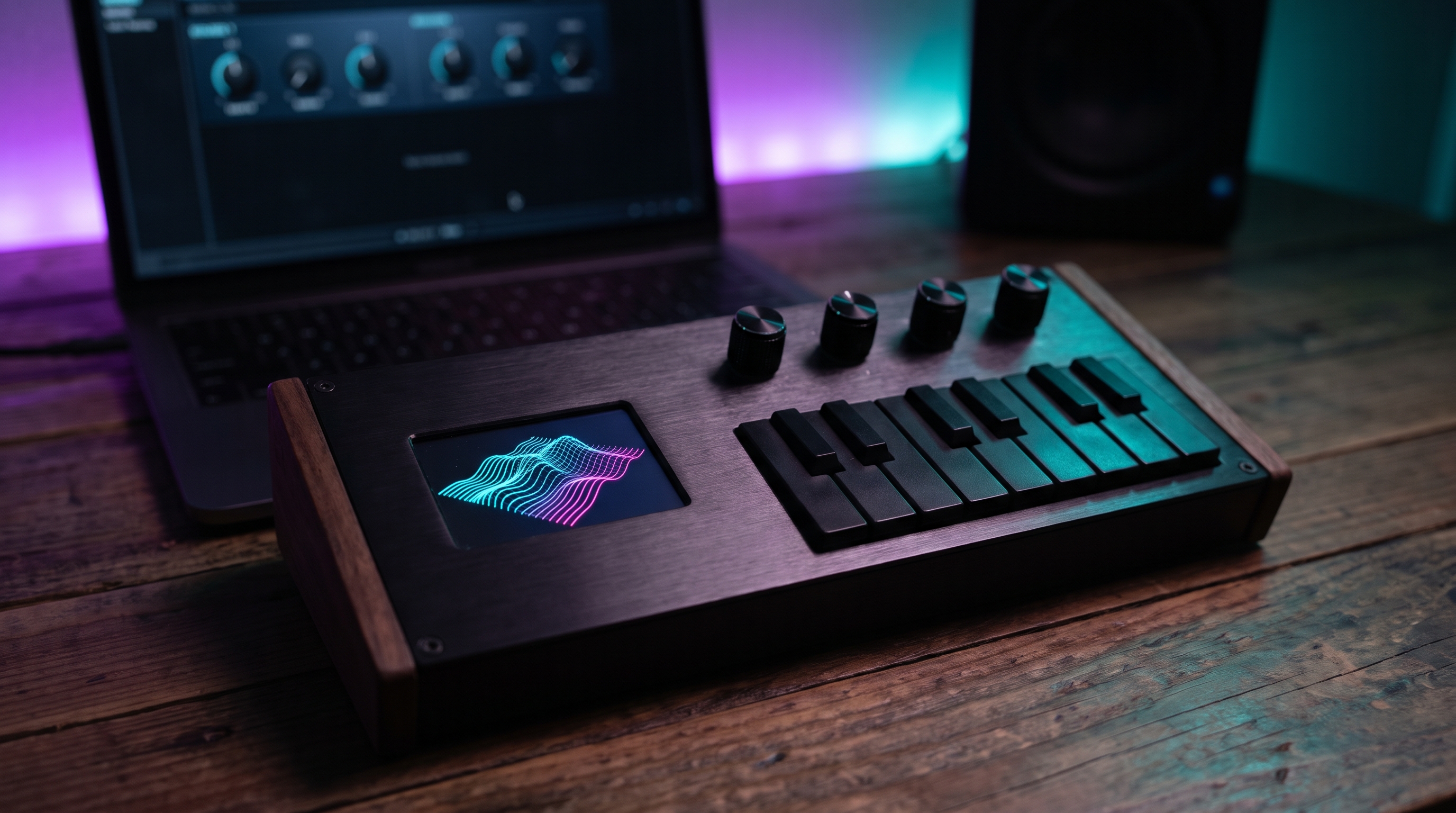
Steve Duda, the creator of Serum, just crammed a stripped-down version of his synthesizer into a little box that, according to MusicRadar, costs about 70 dollars. It's called SHRUB, Xfer Records is releasing it as a free beta, and it's firmware for the M-VAVE FM-1, the pocket synth that has become the favorite toy of the community-made firmware scene. On its official site they sum it up in one line: "Serum, on a small box". For anyone who produces with Serum, this means taking your wavetables, your filters and even your Serum 1 presets to a device that fits in your backpack, and then bringing what you made back to Serum 2.
What SHRUB is
According to the official operation guide (firmware V1.12, November 2026), SHRUB turns the FM-1 into a wavetable synth with "a lot of Serum inside". It comes in two pieces:
- The firmware, which runs on the FM-1 and replaces the factory one.
- The editor, which runs in the browser. You can play SHRUB right there without needing the FM-1 and, if you connect one over USB, edit it live, with all the parameters on a single screen.
The guide makes clear that SHRUB is free, that M-VAVE does not make, sell or support it, and that installing it is at your own risk.
What it includes
According to the official documentation:
- Two wavetable oscillators, plus sub and noise, with Serum's warp modes.
- Serum's filter types: all of Serum 1's and many of Serum 2's, including ladders, combs and phasers.
- Three envelopes with Serum's curves, four LFOs with drawable shapes of up to 17 points, two chaos sources, a 16-slot modulation matrix and four macros.
- A seven-slot effects rack with Serum 1 modules: distortion, flanger, phaser, chorus, delay, compressor (with OTT), reverb, EQ and filter. It says the DSP is ported directly from Serum's effects.
- Arpeggiator with 19 patterns and 51 scales, both taken from Serum 2, plus an eight-lane motion sequencer with 27 sequences, one per key.
- 100 factory presets across 128 slots.
For anyone integrating it into a setup, the guide documents MIDI over USB and over the TRS jack, MPE, 369 NRPNs so a DAW can reach every parameter, MIDI clock sync, USB audio to the computer, and MIDI over Bluetooth.
What gets cut
Duda doesn't pitch it as a full Serum. In the announcement he made on Reddit, quoted by Synth Anatomy, he described it as "sort of a toy Serum feature-wise". The official guide lists the cuts:
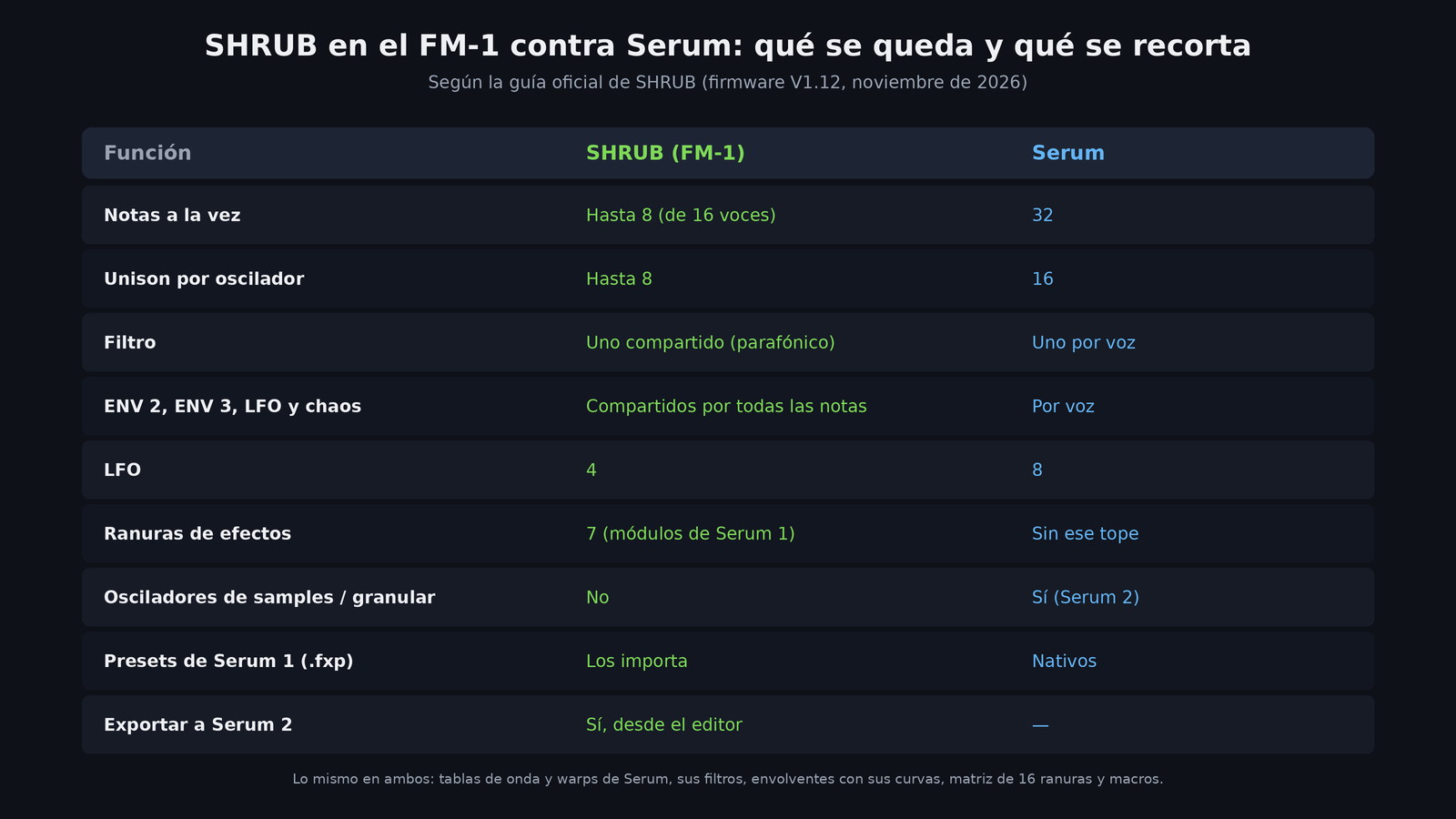
- A single filter for all notes (paraphonic), instead of one per voice. With one note it sounds like Serum; with chords, all the notes share cutoff, resonance and envelope sweep.
- ENV 2, ENV 3, the LFOs and the chaos are also shared across all notes.
- Up to eight notes at once, with unison of up to eight voices per oscillator, out of a total of 16 voices. Heads up: Synthtopia and MusicRadar reported four notes; the V1.12 guide says eight, and SHRUB also measures its own CPU and plays fewer notes with heavy patches.
- There are no sample or granular oscillators, no LFOs 5 through 8, and no Serum 2 clips.
Round trip with Serum
From my point of view, the most useful part for a producer is in the editor:
- Import Serum 1 presets (
.fxp), one by one or a whole folder as a bank, and it tells you what it couldn't translate. - Export to Serum 2 (
.SerumPreset) with the wavetables inside. The guide warns that the arpeggiator, scales and voice control don't carry over, and that chords with a resonant filter will sound fuller in Serum 2 because the filter there is per voice. - It accepts your own wavetables as WAV files with 2,048 samples per frame, up to 64 frames.
MusicRadar adds that there is a free VST3 version for macOS, Windows and Linux, meant as an editor but which works as an instrument in the DAW. According to that outlet, Duda warns that it isn't optimized for desktop and can be heavy on the CPU. I didn't find that version in the official guide I reviewed, so take it as MusicRadar's claim.
How to install it
According to the official installer and the guide:
- Connect the FM-1 over USB and turn it on.
- Close the editor, the M-VAVE updater and any software that uses the FM-1. On Windows, only one program at a time can use its MIDI port.
- Open the installer page in Chrome or Edge, because Safari and Firefox don't have Web MIDI, and press Install. It takes about two minutes.
If your FM-1 has another community firmware and the installer doesn't detect it, you first need to put M-VAVE's V15 or V16 back on it. The guide says the installer never touches the boot code and that you can always go back to the official firmware; if the screen stays black, there's a recovery mode: power the device on while holding OCT− and OCT+ with the cable connected.
I didn't test it: all of this comes from SHRUB's official documentation and the coverage cited.
My take
The FM-1 already had grooveboxes, granular samplers and even Doom, according to MusicRadar, many of them written with the help of AI tools. The difference here is who's signing it: the author of Serum, which MusicRadar describes as the software synth that "reigns" in its category, porting the DSP of his own effects. For a DJ or producer who already lives in Serum, the obvious use is sketching away from the computer: building a bass or a lead on the bus, in the hotel or backstage, and exporting it to Serum 2 to finish it in the studio.
The fine print matters: it's a beta, it's unofficial firmware, and the shared filter limits pads and complex chords. If your FM-1 is your only tool for a show, don't reflash it the day before you play. And if you don't have the device, the browser editor is enough to try how it sounds before spending any money.
Sources
- SHRUB, official site (Xfer Records)
- SHRUB Operation Guide, firmware V1.12
- SHRUB firmware installer
- MusicRadar: Shrub is a free "stripped-down" version of Serum
- Synthtopia: Steve Duda's Free Shrub Brings Serum Wavetable Synthesizer To The M-VAVE FM-1
- Synth Anatomy: Xfer Records Shrub, the little "Serum" brother for M-VAVE FM-1