Music ·
Polyend open-sources the Tracker and drops its biggest update yet: microSD streaming, plugins, and tighter MIDI
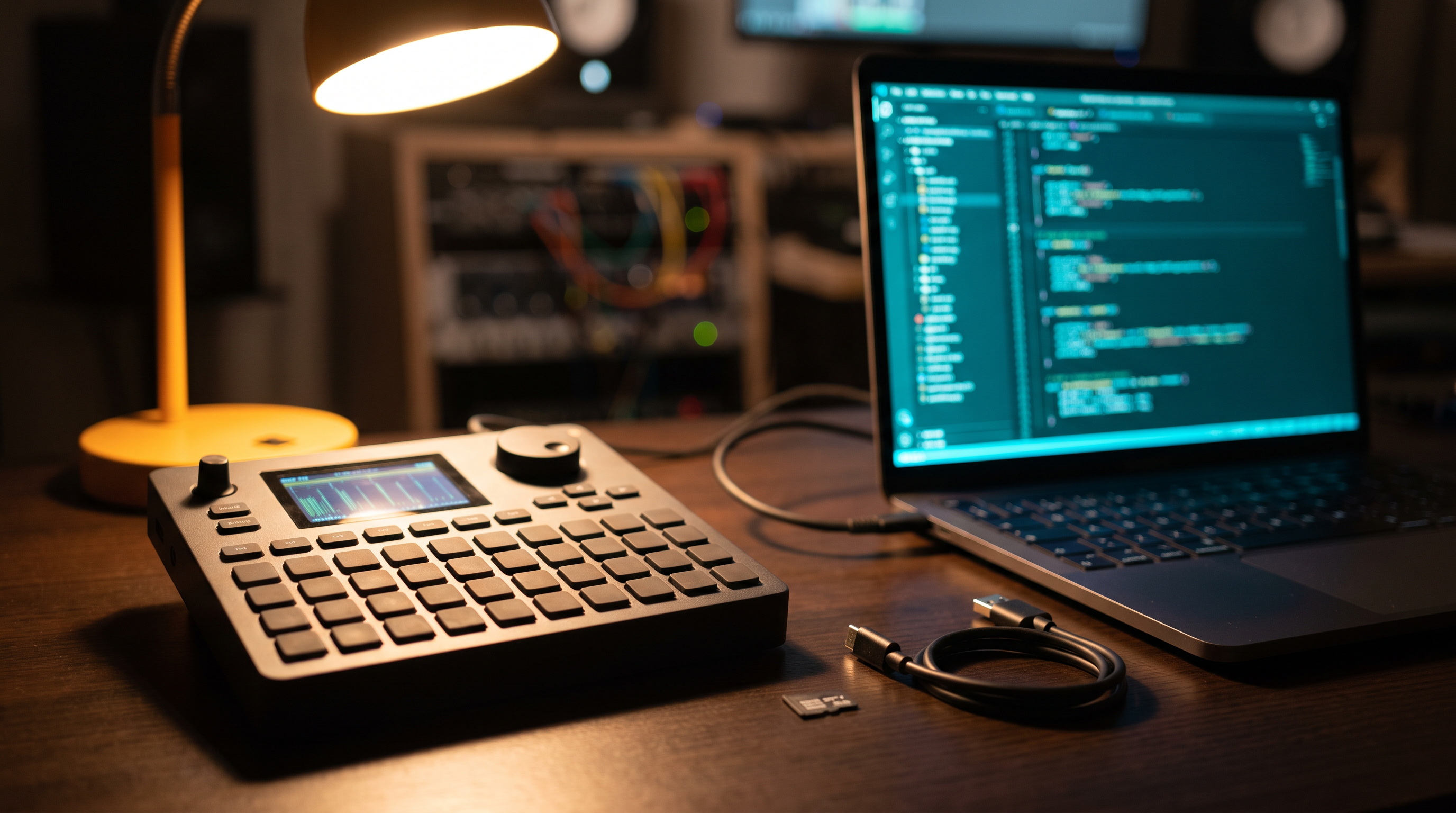
On November 2, 2026, Polyend published the firmware source code for the entire Tracker family: the original, the Tracker+, and the Tracker Mini. It also released Tracker Community Edition 1.0, which the company itself calls its "biggest update": sample streaming from the microSD card, plugins in the sample editor, two new synths, and a much tighter MIDI clock. If you have a Tracker in your rack, as of today you can install the new official firmware, modify it, and share your own version.
What Polyend published
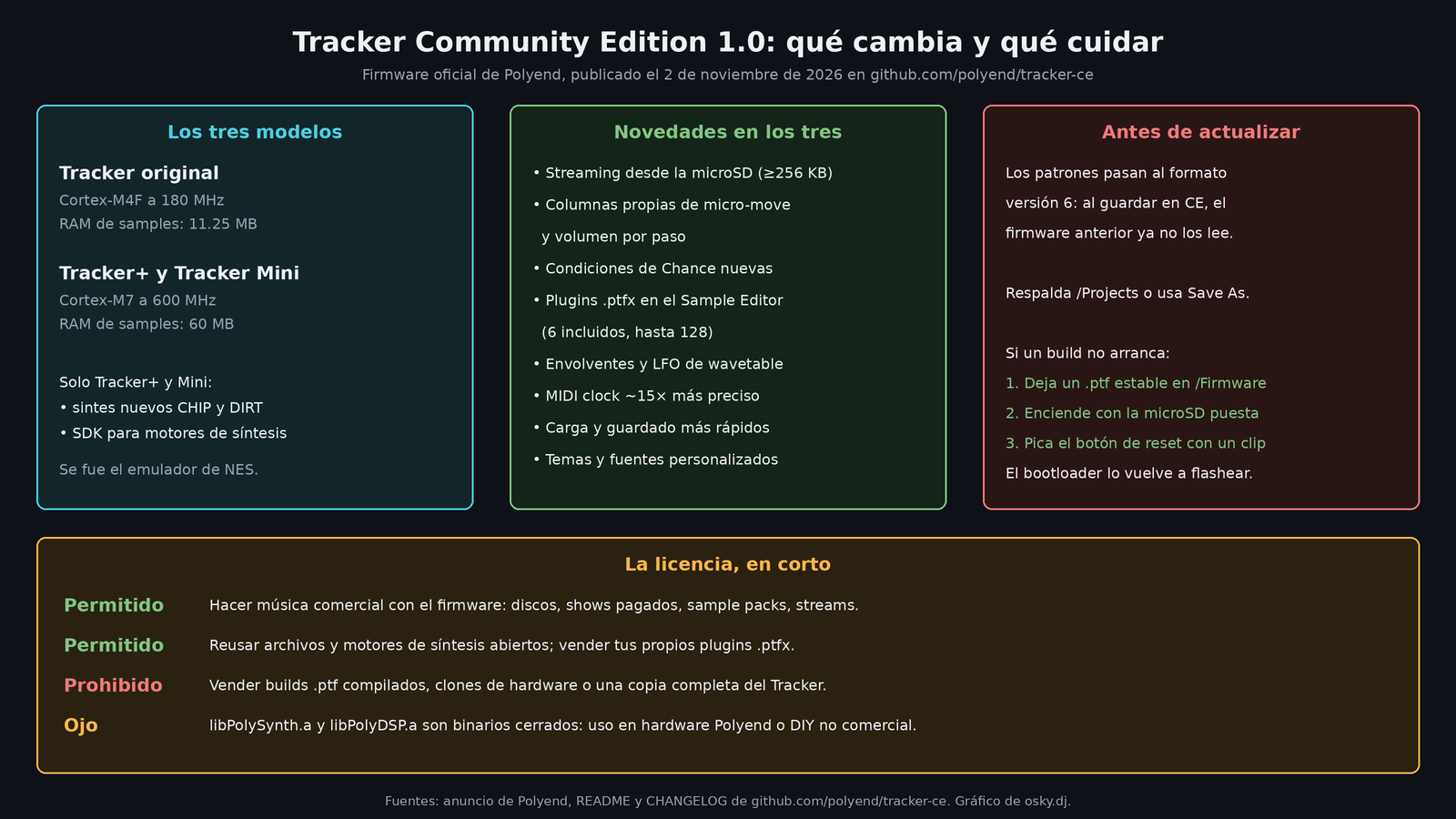
Everything lives in a single repository, polyend/tracker-ce, which builds all three models from the same codebase. The README separates two hardware families: the original Tracker, with a 180 MHz Cortex-M4F, and the Tracker+ and the Mini, with a 600 MHz Cortex-M7. Alongside the firmware come an SDK for building synthesis engines, another for .ptfx Sample Editor plugins, and a theme and font editor that runs in the browser.
Piotr Raczyński, Polyend's CEO, says in the announcement that they opened the code because they were already seeing unofficial community mods and wanted to support that work. His bet: that someone will build "a completely new instrument" on top of the Tracker hardware.
The detail that matters most if you're nervous about experimenting: the bootloader is isolated from the firmware. On the original Tracker it runs on a separate microcontroller; on the Tracker+ and the Mini, in a protected area of flash memory. If a build won't boot, the README says to put a stable .ptf in the /Firmware folder on the microSD, power the unit on, and press the hidden reset button with a paperclip (on the bottom for the original and the Tracker+, next to the USB-C port on the Mini) so the bootloader flashes it again.
What's new in Community Edition 1.0
According to the official changelog, here's what changes the most in practice:
- Streaming from the microSD. Samples of 256 KB or more keep only their attack in memory and the rest is read from the card. Useful for stems, long loops, and field recordings without eating up your sample RAM, which stays at 11.25 MB on the original and 60 MB on the Tracker+ and the Mini. On the original it doesn't apply to Slice and Beat Slice modes.
- Micro-move and volume get their own column. Each step stores its timing and velocity separately, so the two effect slots per step are left free. Recording live without quantizing no longer burns through your FX.
- More Chance conditions. Besides the percentage, there are now "play N times, skip M" style modes, inherited from the Polyend Play. The company's example: dropping in a snare fill every fourth pass.
- Plugins in the Sample Editor. They load from the microSD, up to 128, and six are included: an analog kick generator, stereo delay, multimode filter, chiptune voice generator, mono conversion, and silence. The SDK lets you make your own and sell them.
- CHIP and DIRT. Two new synthesis engines, only for the Tracker+ and the Mini. DIRT is a waveshaping and distortion engine.
- Wavetable envelopes and LFOs on all three models, with 128 factory shapes and 128 user shapes.
- More reliable MIDI. The changelog claims the output clock is about 15 times more accurate and no longer drifts over hours of playback. It also fixes the one-tick-late start with external clock, adds support for
ContinueandSong Position Pointer, and fixes USB MIDI on Windows 11 after its March 2026 update. - Projects that open and save faster.
For anyone who plays live or syncs the Tracker with a DAW or a drum machine, the MIDI clock fix is the most valuable thing on the whole list. My take: a clock that drifts during a two-hour set isn't fixed with pretty plugins.
Before you update: back up your projects
There's one change that doesn't undo itself. To make room for the new micro-move and volume columns, patterns move to a new format (version 6). Old projects open without a problem, but as soon as you save them with the CE, the previous firmware can no longer read them. Polyend recommends backing up the Projects/ folder on the microSD or using Save As if you plan to go back to an earlier version.
Support changes too: the README makes clear that the Community Edition is delivered "as is," with no obligation of technical support. If something gets damaged from using modified firmware, the warranty doesn't cover it, although the company offers paid out-of-warranty repair. They also removed the NES emulator to free up memory ("sorry, gamers," says the changelog).
The files in the v1.0.0 release are PolyendTracker_CE_1.0.0.ptf, TrackerMini_CE_1.0.0.ptf, and TrackerPlus_CE_1.0.0.ptf. I haven't tested it on hardware; all of this comes from the official documentation.
Is it really open source?
Depends on how strict you are. The code, the SDKs, and the open engines are under an MIT license with one restriction: you can't sell compiled builds of the firmware, clone hardware, or a full copy of the application. Making commercial music with it (records, paid shows, sample packs, streams) is expressly allowed, as is selling your own plugins. In addition, two synthesis and DSP libraries come as closed binaries (libPolySynth.a and libPolyDSP.a), free to use on Polyend hardware or in non-commercial DIY projects. The repository history shows the license was updated on November 3, one day after the release.
My take: for the musician it makes no difference, because you can use it, change it, and charge for your music without asking permission. For the purist, a license that prohibits certain commercial uses doesn't fit the classic definition of open source (commenters on Synth Anatomy already pointed this out).
Why it matters
According to Synth Anatomy, Polyend arrives after Behringer announced open firmware on its gear, in what the outlet describes as a strong shift in the music tech market driven by AI. What sets Polyend apart is that it didn't just drop the code and leave: it paired it with a feature-packed official firmware and a safety net so you don't brick your unit.
My final take: a groovebox that stops getting updates becomes a paperweight with pads. One with open code and a community behind it can last years longer than its maker ever planned.
Sources
- Polyend: Tracker. The biggest update yet (official announcement)
- polyend/tracker-ce repository on GitHub (README and license)
- Tracker Community Edition 1.0 CHANGELOG
- Polyend Tracker CE v1.0.0 release
- Tracker web theme and font editor
- Synth Anatomy: Polyend Tracker family now open-source
- MusicRadar: Polyend's Tracker, Tracker Mini and Tracker+ go open source