Music ·
Photophore 2: the flock synth is now an AUv3 plug-in and comes to iPhone
Taika Systems has released Photophore 2, the second version of its "flock synth" for iOS, and it delivers exactly what its users have been asking for over more than ten years: it works as an AUv3 plug-in inside other music apps and now also runs on iPhone, not just iPad. Photophore doesn't imitate analog circuits: it simulates a flock of up to 100 oscillators flying around a 3D habitat, and that movement is what detunes and opens up the sound. It costs $7.99 until November 30; after that it goes up to $14.99. If you produce on iPad or iPhone, this week is the one to buy it.
Disclaimer: I haven't tried it. What follows comes from the official App Store listing, the Taika Systems website, and coverage from CDM and The Beat Community, cited at the end. Where there is opinion, it's marked as such.
What flock synthesis is
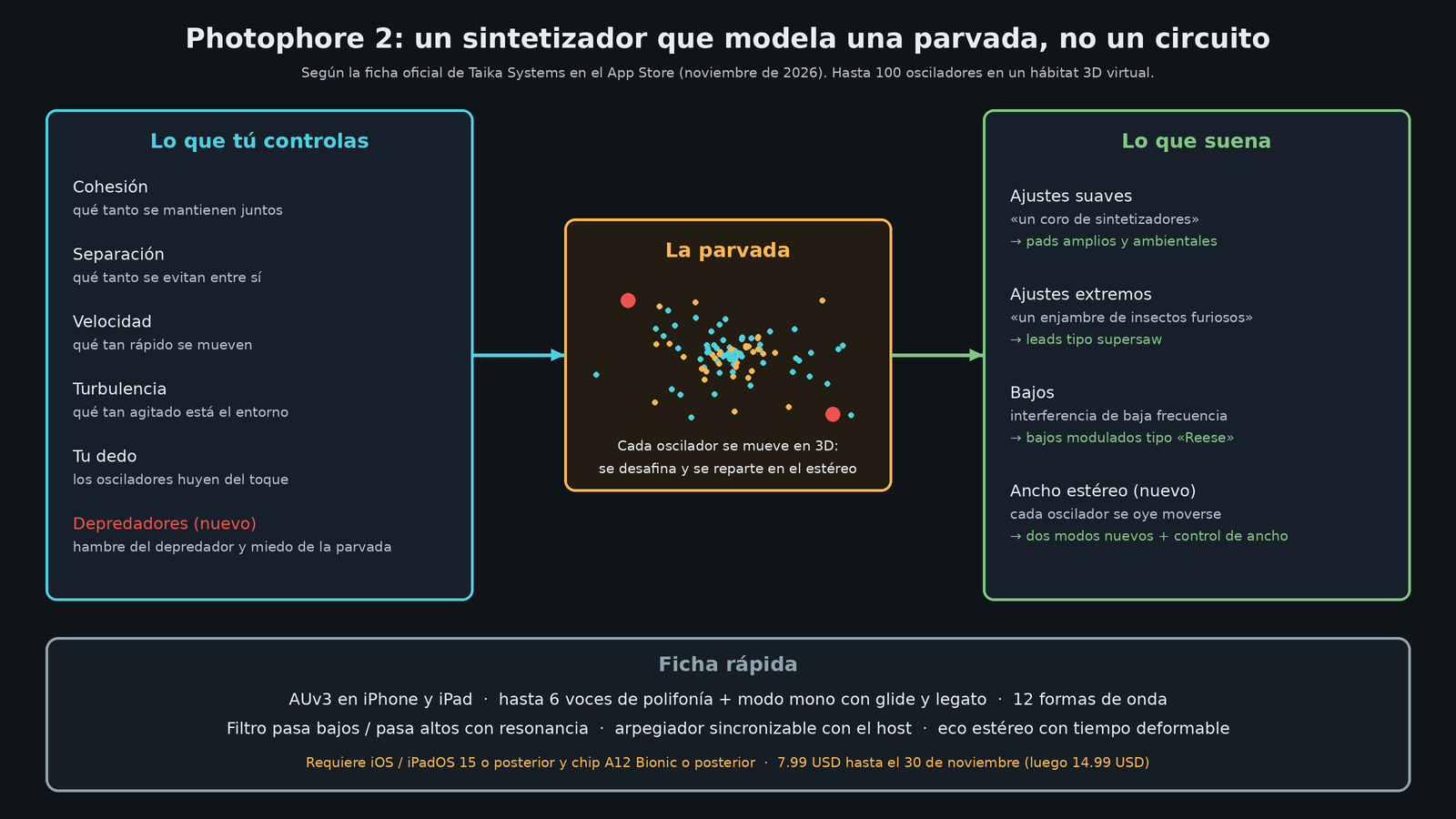
The idea was born in 2014, when CDM covered the first version for iPad. According to Taika Systems, the sound engine is a flock of up to 100 oscillators that move through a virtual 3D environment. As they travel, the oscillators "naturally detune and spread across the stereo field." The result, says the maker, works for huge basses, complex pads, and swarm-like leads.
You don't turn detune knobs: you control the behavior of the flock.
- Cohesion: how much the oscillators want to stay together.
- Separation: how much they avoid each other.
- Speed and turbulence of the environment.
- Your finger: the oscillators flee when you touch the screen, so sweeping your finger becomes a pretty wild pitch modulation.
The listing sums it up like this: with gentle settings it sounds like "a choir of synthesizers"; with extreme settings, like "a swarm of angry insects."
What version 2 brings
According to the App Store listing, here's what's new:
- AUv3 plug-in. It works inside GarageBand, Logic Pro, AUM, Loopy Pro, and other compatible hosts. CDM and The Beat Community specify that Logic Pro refers to the iPad version; CDM also mentions Cubasis.
- iPhone. The engine and interface were optimized for the phone screen. The Beat Community, in its November 17 article, adds that a dedicated layout for iPhone Duo is planned for an update.
- Predators. You can drop "hunters" into the flock for unpredictable modulation. They're controlled with two parameters: the predator's hunger and the flock's fear.
- Flock-driven stereo width. Each oscillator can be heard moving across the stereo field, with two new stereo modes and an additional width control.
- Redesigned interface, dark and minimalist, with smoother flock movement.
- New library: 30 artist presets made by Bop (Alexander Dmitriev), who also produced the demos on the official site.
- More efficient engine, to allow more instances of the plug-in at once.
CDM also mentions host tempo sync, a rebuilt stereo delay with tape-style time shifts, and importing presets from Photophore 1. A user review on the App Store also confirms they were able to bring over their presets from the first version.
The spec sheet
| Item | Photophore 2 |
|---|---|
| Oscillators | Up to 100, controlled by the simulation |
| Polyphony | Up to 6 voices, plus mono mode with glide and legato |
| Waveforms | 12, including saw, square, pulse, and sine |
| Filter | Low-pass and high-pass with resonance, with dedicated filter and amplitude envelopes |
| Extras | Keyboard latch, host-syncable arpeggiator, stereo echo with warpable time |
| MIDI | Supports MIDI keyboards; the mod wheel controls the flock's movement |
| Requirements | iOS or iPadOS 15 or later and A12 Bionic chip or later |
| Price | $7.99 USD until November 30, 2026; after that, $14.99 USD |
The app weighs 16.1 MB and is listed on the App Store under Taika Systems LLC. According to the listing itself, it's designed and programmed by an independent developer, Nick.
What this means
My take: the important thing isn't the number of oscillators, but the AUv3. The first version was a standalone app. You could record something nice, but getting it into a production meant exporting audio and losing control. As a plug-in, the flock lives inside AUM, Loopy Pro, or Logic for iPad, with its tempo and its automation, and that makes it a work tool and not a toy.
For anyone producing house, techno, or ambient stuff, the three uses the maker promises land right where it hurts: pads that breathe on their own, supersaw-style leads with their own movement, and modulated "Reese"-style basses. Peter Kirn of CDM describes it as "trippy, hypnotic" and says he ended up working from the iPhone alone.
The context also strikes me as significant. Kirn and several App Store users contrast Photophore with the wave of music apps rushed out with AI. Here there's a synthesis idea with twelve years of history that its author kept maintaining; one user says version 1 kept working through a decade of iOS updates.
What we still don't know
- The listing doesn't mention a Mac or Windows version; for now it's iPhone and iPad only.
- The iPhone Duo layout is announced as something for the future, with no date.
- There's no public information on how much CPU it uses with several instances on older devices. The maker only says the engine is more efficient.
If you have an iPad or iPhone with an A12 chip or newer and you like pads with a life of their own, $7.99 is low risk. But the offer ends November 30.
Sources
- Photophore Synth 2 on the App Store (Taika Systems LLC)
- Taika Systems official website
- CDM: Photophore 2, a 100-oscillator iOS/AUv3 flock synth twelve years in the making
- The Beat Community: Taika Systems Release Photophore 2 – For iOS
- CDM (2014): Angry Bees! Swarms and Flocks of Sound in a New iPad Synth