Music ·
Nick Cave vs. Suno: "an affront" to songwriters, and why it's not a change of heart
Nick Cave has taken aim at AI-generated music again, and this time he's naming names. In issue #381 of The Red Hand Files, the newsletter where he answers fan questions, published in November 2026, he called Suno "the Great Canceller" and described song-generating platforms as "perhaps our final, most soul-destroying humiliation" (translations are mine). It's not a product announcement or a new law, but it is one of the most respected voices in songwriting taking a stand just as these platforms are already in court. And for anyone who produces, spins or writes music, the question it leaves is uncomfortable and very practical: what is your music worth when a machine makes "a song" in fifteen seconds?
What he actually said
The letter answers two questions at once. Nuno, from Porto, asks whether he still believes the art can't be separated from the artist. Catherine, from Bristol, has just watched a documentary about AI and asks whether he's a "doomer or a boomer."
Cave starts with the first one: art and artist are inseparable, "like the waves of the sea they rise from," and for him the matter was settled. "Until now," he writes. His argument is that song-generating platforms do separate the art from the artist, and remove the artist from the equation altogether. Of Suno he says it has never loved, laughed or grieved, and yet it produces "an imitation of the soul" in "fifteen seconds." He calls it "an affront" to any songwriter who has lived, struggled and earned the right to write a song.
He answers Catherine more cautiously than the headlines suggest: AI, he says, could save the world, destroy it, or land somewhere in between, and he admits "I don't know." But he sees in song platforms a hint of the technology's "demonic potential" to hollow out human effort and reduce its fruits to "mere products." He closes with a jab at those who want to "cancel" problematic artists: these platforms, he quips, promise to rid the world of artists altogether.
Did he change his mind again?
That's how Paste frames it: Cave criticized AI, then in 2025 released an AI-made "Tupelo" video, and now he's condemning it again. My reading is different, and it comes from his own letters.
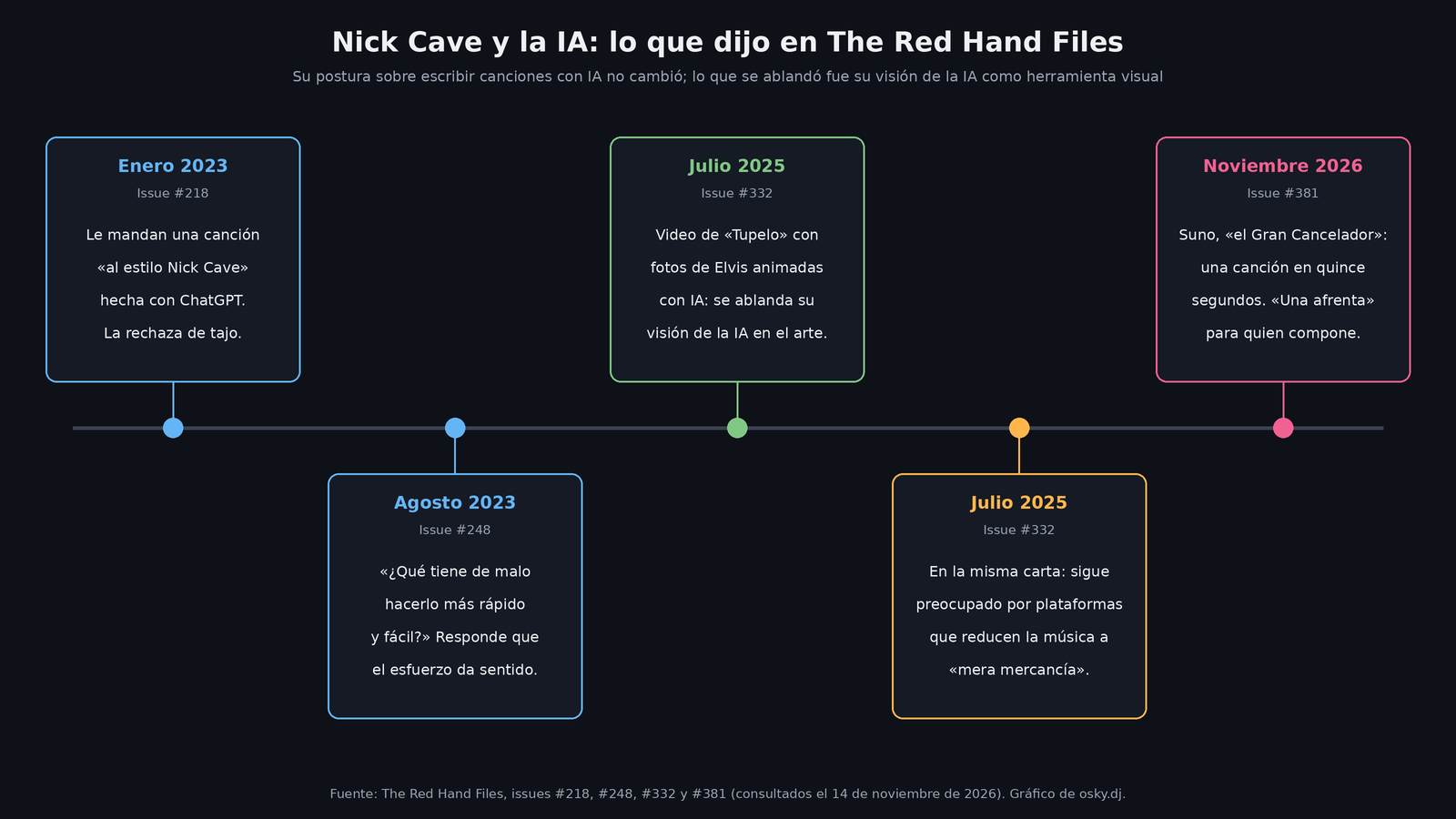
In January 2023 (issue #218) a fan sent him a ChatGPT-made lyric "in the style of Nick Cave" and he tore it apart. In August 2023 (issue #248) he was asked what's wrong with making things "faster and easier," and he answered that creative struggle is what gives the work its meaning. In July 2025 (issue #332), filmmaker Andrew Dominik gave him a video for the 40th anniversary of "Tupelo," with archival photos of Elvis animated using AI. Cave wrote that his view of AI "as an artistic resource" had softened and that changing your mind is a form of strength.
But in that same 2025 letter he wrote that he was still concerned about platforms that reduce music to "mere commodity" by eliminating the artistic process. In other words: what shifted was his stance on AI as a tool in an author's hands (a director animating photos to tell something). What hasn't moved in three years is his rejection of AI that replaces the author. The November 2026 letter is consistent with that; what's new is the tone, and that he now names the platform.
The context: Suno isn't having its best moment
Cave isn't speaking in a vacuum. On July 31, 2026, the Munich I Regional Court ruled largely in favor of GEMA, the German music rights society, against Suno. According to the analysis by law firm Bird & Bird, it's the first European case on a generative music tool: the court barred training on six works from GEMA's repertoire, their memorization in the model and their reproduction in outputs, and ordered Suno to pay damages. Suno can appeal. Paste adds that the company faces several copyright lawsuits, including a class action filed by musician Jason Isbell.
Cave's letter isn't a legal argument: it's moral and almost religious. But it lands just as the legal debate has begun to side with authors in at least one European court, and that gives it more weight than an isolated complaint would have.
What this means for people who make music
Here's my take, for DJs, producers and event people:
- The line Cave draws is useful even if you don't share his tone. Using AI to separate stems, clean up a recording, animate visuals or speed up a workflow is one thing. Asking a platform for the whole song and signing it as yours is another. The first still has an author; the second, according to Cave, no longer does.
- Value is shifting to the process. If generating audio is cheap, what's scarce is what can't be generated: the judgment to choose, the hand-built set, the story behind the track. For a DJ that isn't philosophy, it's positioning.
- The legal risk is real. With rulings like Munich's, using material generated by platforms whose training is in litigation in a commercial release stops being just a matter of taste. If you're going to publish something made with them, check their terms and the status of their lawsuits.
- Audiences can tell the difference, at least for now. When a figure like Cave says "affront," it gives vocabulary to a part of the public that already distrusts synthetic music. For anyone building an artist brand, being transparent about how you use AI is already part of the job.
Cave doesn't propose banning anything or offer a technical way out. What he leaves is a question everyone in music will have to answer in their own studio: where does the tool end and the replacement begin?
Sources
- The Red Hand Files, issue #381 (November 2026)
- The Red Hand Files, issue #332, on the "Tupelo" video (July 2025)
- The Red Hand Files, issue #248 (August 2023)
- The Red Hand Files, issue #218 (January 2023)
- Euronews: coverage of the letter
- MusicRadar: coverage of the letter
- Paste: "Nick Cave calls AI demonic a year after using it in a music video"
- Bird & Bird: analysis of the GEMA v. Suno ruling in Munich