Music ·
Moog Gets Into Amplifiers: Model 112 and Model 210, Two Combos That Won't Change the Sound of Your Synths

Moog, the brand that has spent decades making synthesizers, released something on October 27 that nobody was asking for out loud but that a lot of people needed: two amplifiers. The Model 112 and the Model 210 are full-range, flat-response (FRFR) combos designed for synths, keyboards, drum machines, and any electronic source. They are already on sale: $799 for the 112 and $999 for the 210. If you've ever plugged a synth into a guitar amp and heard it swallow your low end, this article is for you.
What problem are they trying to solve
A guitar or bass amp is made to color the sound: its EQ, its speakers, and its clipping are part of the instrument. With a guitar, that's a virtue. With a synth that drops down to 40 Hz, a 909 with sharp transients, or a carefully crafted stereo pad, it's a nuisance: you lose bass, the highs get squashed, and the stereo image collapses to mono.
Moog takes the opposite approach. According to its press release, both models use flat-response amplification to reproduce the frequency range, dynamics, and character of whatever you plug in, without adding a personality of their own. Joe Richardson, president of Moog Music, summed it up like this: the amplifiers were designed to "preserve that identity, not color it."
The other selling point is latency. Many FRFR systems and powered speakers put DSP in the signal path. Moog says the amplification path here is entirely analog, with no digital processing adding latency; on its site it describes this as "effectively zero perceptible latency". One technical nuance: the press release clarifies that the power stage is Class D, which is analog in the sense that it doesn't go through a digital processor, even though it works by switching.
Model 112: the one that fits in the car
The Model 112 is the portable one in the family. According to the official spec sheet:
- 440 W RMS (880 W peak), in a bi-amped system.
- One 12-inch speaker and a 1-inch compression driver.
- Response from 49 Hz to 20 kHz at -3 dB, and from 40 Hz to 20 kHz at -10 dB.
- 100° × 100° coverage.
- 21.7 kg (about 48 lb) and a top handle.
Moog positions it for studio use, rehearsals, small gigs, and personal stage monitoring.
Model 210: the one that goes lower
The Model 210 is the flagship. It uses a 2.5-way design with two 10-inch speakers: according to the press release, one works full-range and the other focuses on low frequencies. Its official numbers:
- 550 W RMS (1,100 W peak), bi-amped.
- Response from 38 Hz to 20 kHz at -3 dB, and from 35 Hz to 23 kHz at -10 dB.
- 31.7 kg (about 70 lb), with side handles and removable wheels.
Moog aims it at bigger stages and demanding rigs, with an emphasis on synth bass, electronic drums, and bass modelers.
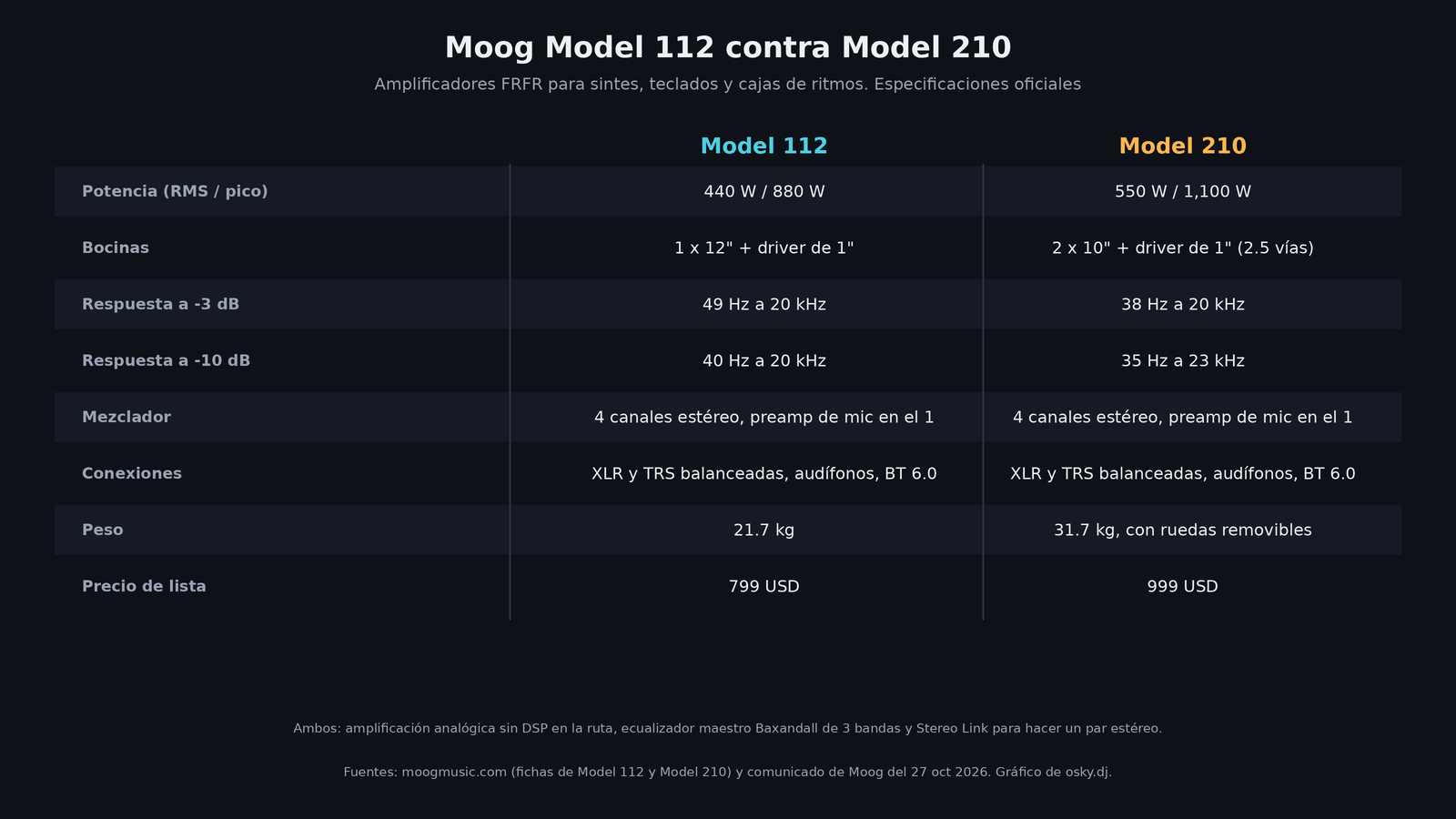
One thing to watch out for: the press release gives 40 Hz–20 kHz for the 112 and 35 Hz–23 kHz for the 210, but those are the -10 dB figures. At -3 dB, which is the more demanding measurement, the spec sheet says 49 Hz and 38 Hz. It's not misleading, but you should compare them using the same yardstick when you put them next to other speakers.
What they share: a mini mixer inside the amp
Here's the most interesting part for anyone who plays with several pieces of gear. Both models come with:
- 4-channel stereo analog mixer, with a mic preamp on channel 1.
- 3-band Baxandall master EQ for the whole mix.
- Balanced stereo XLR and TRS outputs to send the full mix to the venue's system while the amp stays on as your monitor.
- Headphone output for practicing in silence.
- Bluetooth 6.0 (A2DP and AVRCP) to play along with reference tracks.
- Stereo Link to join two compatible amplifiers for true stereo.
The cabinet is wood covered in Tolex, with metal corners and vintage-style grille cloth. That seventies amp look has already sparked comments: on Synthtopia, some compared it to a Fender, and others celebrated that a synth amp finally doesn't look like a PA speaker.
What this means for DJs, producers, and event people
My take: for a hardware live act, with a couple of synths, a drum machine, and maybe a sampler, the value is in the built-in mixer plus the output to the venue's console. You show up, plug in four stereo sources, send the mix via XLR to the engineer, and keep your own monitor right next to you. You save yourself the small mixer, the monitor speaker, and a tangle of cables.
As for DJs, Moog doesn't sell it as a booth monitor, and nobody has tested it that way yet. By the specs, nothing stops you from connecting a mixer's booth output to one of its stereo inputs, but a booth monitor usually lives in a corner and 31.7 kg doesn't move by itself. For a home studio, the 112 makes sense as a system for playing your synths without turning on the computer or the audio interface.
The most repeated criticism is well founded: many stages have already moved to in-ear monitoring and going straight to the PA, with no amps on stage. For that workflow, a 30-kilo combo is overkill. Where it does fit is in small and mid-sized venues, band rehearsals, and places where the house monitoring is a lottery.
As a fun fact, Gearnews points out that Bob Moog was already selling guitar and bass amplifiers by catalog in the mid-sixties, while he was developing his modulars. It also notes that Moog isn't the only synth brand to get into amplification this year: Teenage Engineering launched its EP-35 K.O. AMP.
Price and availability
According to the press release published on October 27, 2026, both are already on sale through authorized dealers:
- Model 112: 799 USD, 799.99 € or 679.99 £.
- Model 210: 999 USD, 999.99 € or 849.99 £.
In Europe they already appear below list price: Gearnews reports 769 € and 969 € at Thomann. Moog has not published pricing for Mexico. Nothing in this article comes from our own testing: everything comes from Moog's official documentation and the coverage cited below.
Sources
- Moog Music: Model 112, página oficial y especificaciones
- Moog Music: Model 210, página oficial y especificaciones
- Synthtopia: comunicado de Moog sobre Model 112 y Model 210
- Sound On Sound: Moog launch the Model 112 & Model 210 amps
- Gearnews: Moog Amps, Model 112 and Model 210
- MusicRadar: Moog's new line of instrument amps