Music ·
Mixxx wants to be the free brain of DJ standalones: its plan to unite all the embedded forks
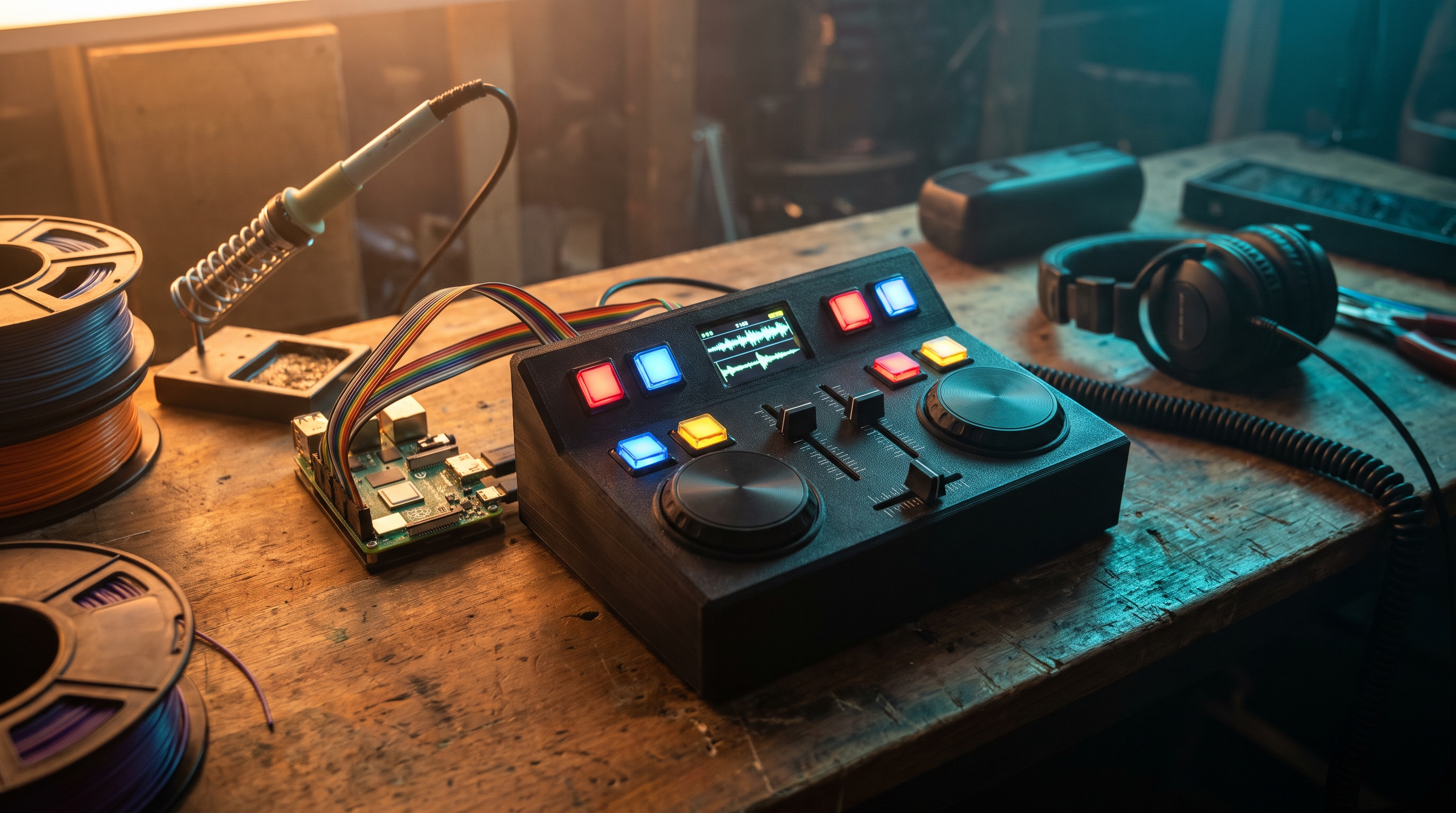
Mixxx, the free DJ software that has been running on Windows, macOS and Linux for years, wants to make the jump to standalone gear. On November 2, 2026, Daniel Schürmann, a core developer on the project, published a proposal on the official blog called "Mixxx on Bare Metal". The idea is to bring together into a single codebase all the experiments that today run Mixxx on Raspberry Pi, homemade controllers and modified commercial gear, and to offer official builds for embedded hardware. It matters because it arrives just as Behringer is showing off an "open" four-channel standalone, and because it puts on the table a question that should make any DJ uncomfortable: who do your cue points belong to?
What exactly Mixxx is proposing
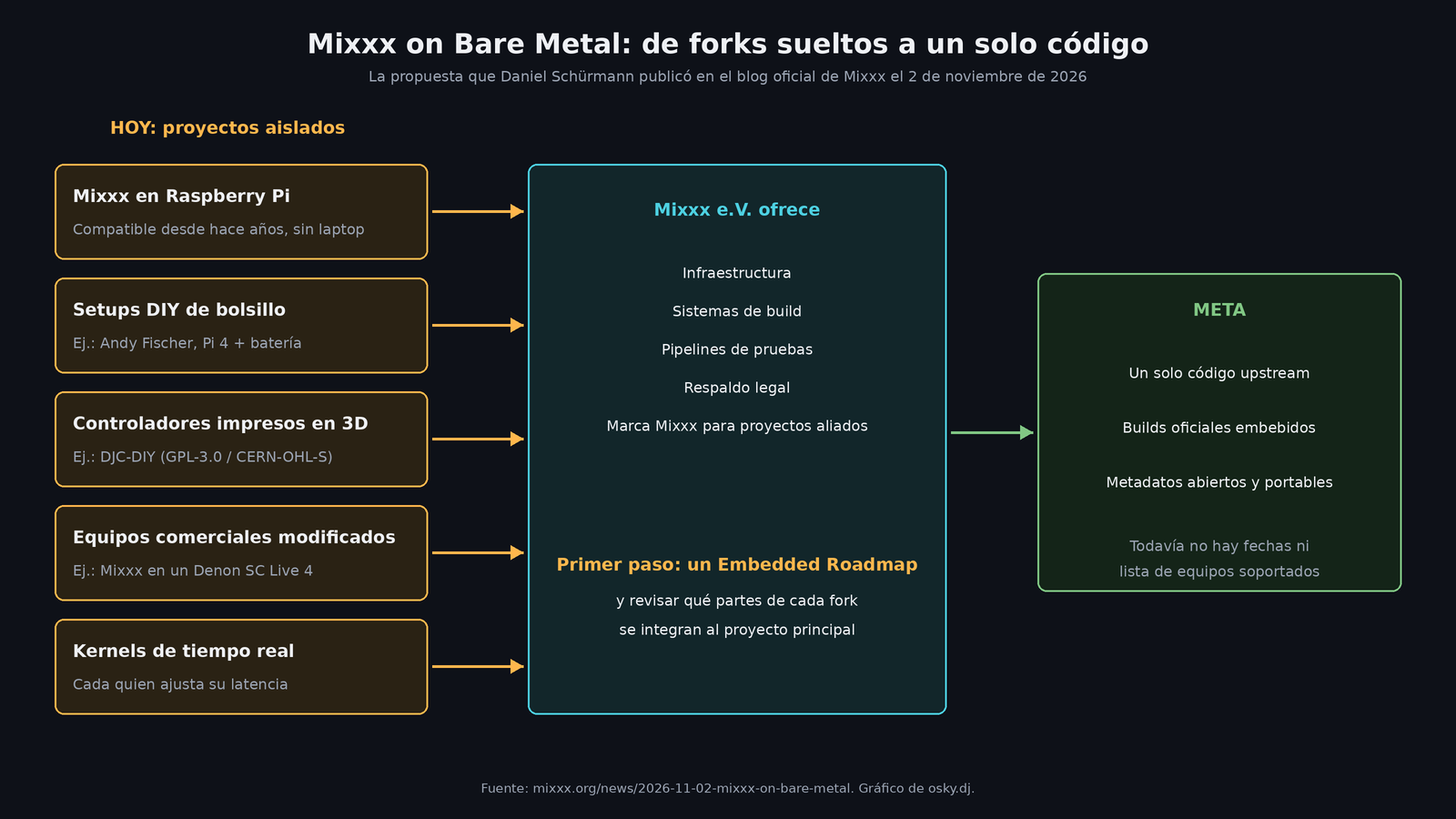
Schürmann starts from something that already exists. According to the post, Mixxx has supported the Raspberry Pi and similar boards for years so you can play without a laptop, and the community has gone much further: custom Linux images, 3D-printed controllers and tuned real-time kernels that squeeze very low latencies out of low-power CPUs. The problem, he says, is that each project lives in isolation in its own fork.
What the Mixxx team and its association, Mixxx e.V., are offering is concrete:
- Infrastructure, build systems, testing pipelines and legal backing to bring those efforts together.
- A single upstream codebase, so that anyone putting together an embedded setup gets "a solid, officially supported build" from the start, instead of relying on a fork someone stopped maintaining.
- Official partnerships: independent projects will be able to partner with Mixxx e.V., which could allow them to use the Mixxx brand.
The first step isn't code, but an Embedded Roadmap: a thorough review of what has been done in the existing forks and identifying what is ready to be integrated into the main project. The post includes no dates and no list of supported devices.
The projects that already exist
The proposal cites real examples, and they're worth a look to understand how big the terrain is:
- "The smallest possible digital DJ-Setup", by Andy Fischer: Mixxx on a Raspberry Pi 4 inside a 14 × 15 × 6 cm case weighing half a kilo, with a battery for about 2.5 hours. Fischer estimates the prototype cost him around 180 euros in parts.
- DJC-DIY, by MandićLab: a controller you build at home with 3D-printed parts, designed for Mixxx. The software is under GPL-3.0 and the hardware under the CERN-OHL-S-2.0 license.
- Mixxx on a Denon DJ SC Live 4: the post links a video of Phil Willoughby (DJ WillerZ) running Mixxx on that commercial standalone.
Each one solves a piece of the problem. None of them, on its own, is something you'd hand to a DJ who has to play on Saturday.
The backdrop: Behringer and the ANIMA
Peter Kirn, of CDM, says it bluntly: the proposal is "obviously" motivated by a manufacturer showing off an "open" unit, even though the community's work came first. The Mixxx post itself mentions it: it says it welcomes Behringer's Klark Teknik ANIMA, which it describes as affordable DJ hardware with an open architecture.
What's known about the ANIMA comes from prototype photos that Behringer posted on Facebook on October 27, according to DJ TechTools: four channels, eight pads per deck, long pitch faders and a foldable touchscreen in the center. On the back it has a bay labeled "HARD DISK", USB, Ethernet, XLR outputs and two mic inputs. The target price is $300 to $400; DJ TechTools notes that the first version of the post said $400 to $500 and that it was lowered in under an hour. There is no spec sheet and no release date.
DJ TechTools also points out the obvious: Rekordbox and Serato don't run on Linux, so if the ANIMA arrives with free software, Mixxx is the natural candidate. My take is that Mixxx is doing the smart thing: planting itself as the official base before every manufacturer and every enthusiast puts out their own fork and the ecosystem turns into a Tower of Babel.
Your data, your library
The sharpest part of the post is the one about data. Schürmann accuses the industry of continuing with aggressive lock-in and gives as an example AlphaTheta's OneLibrary / Device Library Plus formats, which he says use SQLite databases encrypted with SQLCipher to keep users from freely moving their metadata, cue points and beatgrids between platforms. That is Mixxx's accusation, not a position AlphaTheta has confirmed.
His counteroffer is clear: with Mixxx on embedded hardware, track metadata would be unencrypted, accessible and portable. In his words, a DJ's annotations, playlists and crates "belong to the DJ".
For anyone who plays in clubs, this isn't philosophy. It's the difference between being able to switch gear with all your prep work intact and having to re-mark hundreds of cue points by hand.
What it needs to become real
The post doesn't pitch itself as a finished product; it's a call to action. Mixxx is looking for volunteers: embedded systems engineers, software architects, interface designers, code reviewers, testers, technical writers, marketing people and usability researchers. The invitation is to join their Zulip chat.
There's a paragraph every software team should read twice. Schürmann writes that in the era of AI programming, generating code is cheap and easy, and that the real challenge is careful review, deep debugging and an architecture that can be maintained over the long term. For a live audio system, where a latency glitch means silence in front of the crowd, that weighs double.
What we still don't know
- There's no timeline for the Embedded Roadmap and no list of boards or devices with official support.
- It's not known whether Behringer will use Mixxx in the ANIMA or whether it will publish its drivers.
- The ANIMA's price and date are still targets, not commitments.
My take: if Mixxx manages to get people to review and maintain it, this could be the first free standalone that doesn't depend on the goodwill of a single hacker. If not, it'll be just another forum thread full of forks. For now, the door is open and the invitation is public.