Music ·
Malfunction v3: Sinevibes revives its circuit-bent filter with a wilder B mode and 4× oversampling
On October 30, 2026, Sinevibes released Malfunction v3, the third generation of its "circuit-bent" filter for Mac, Windows and Linux. The core idea hasn't changed since 2013: a filter model whose internal connections were deliberately tampered with, as if someone had jammed a wire in where it doesn't belong. What's new is everything around that algorithm: a second character mode, 4× oversampling to tame aliasing, an input noise gate, a more serious multimode filter and two LFOs with 15 waveforms. It costs $29 and there's a demo. If you make techno, acid or electro and are always asking your loops to sound like a broken machine, this is one of those little tools that can change a session.
Upfront disclaimer: I haven't tested it. What follows comes from the plugin's official page, its manual and Sinevibes' announcement; anything that's my own interpretation is marked as such.
What is a "circuit-bent" filter?
Circuit bending is the practice of opening up cheap electronic devices (toys, keyboards, drum machines) and bridging their circuits to get sounds the manufacturer never planned. The technique is credited to Reed Ghazala, as CDM recalls in its review.
Malfunction does that in code. Sinevibes describes it as an experimental algorithm: a filter model "whose internal connections have been intentionally tampered with." The result, according to the manufacturer, is a "rough and screaming" distortion that turns simple sounds into glitchy, harsh, unpredictable textures.
What version 3 brings
According to the product page and the version 3.0.0 manual:
- Two character modes in the circuit-bent filter: A, which the manual calls "intense," and B, "extreme." B is completely new.
- 4× oversampling to suppress aliasing. Sinevibes told CDM this makes the sound "much less harsh" without losing the "circuit-bent" quality.
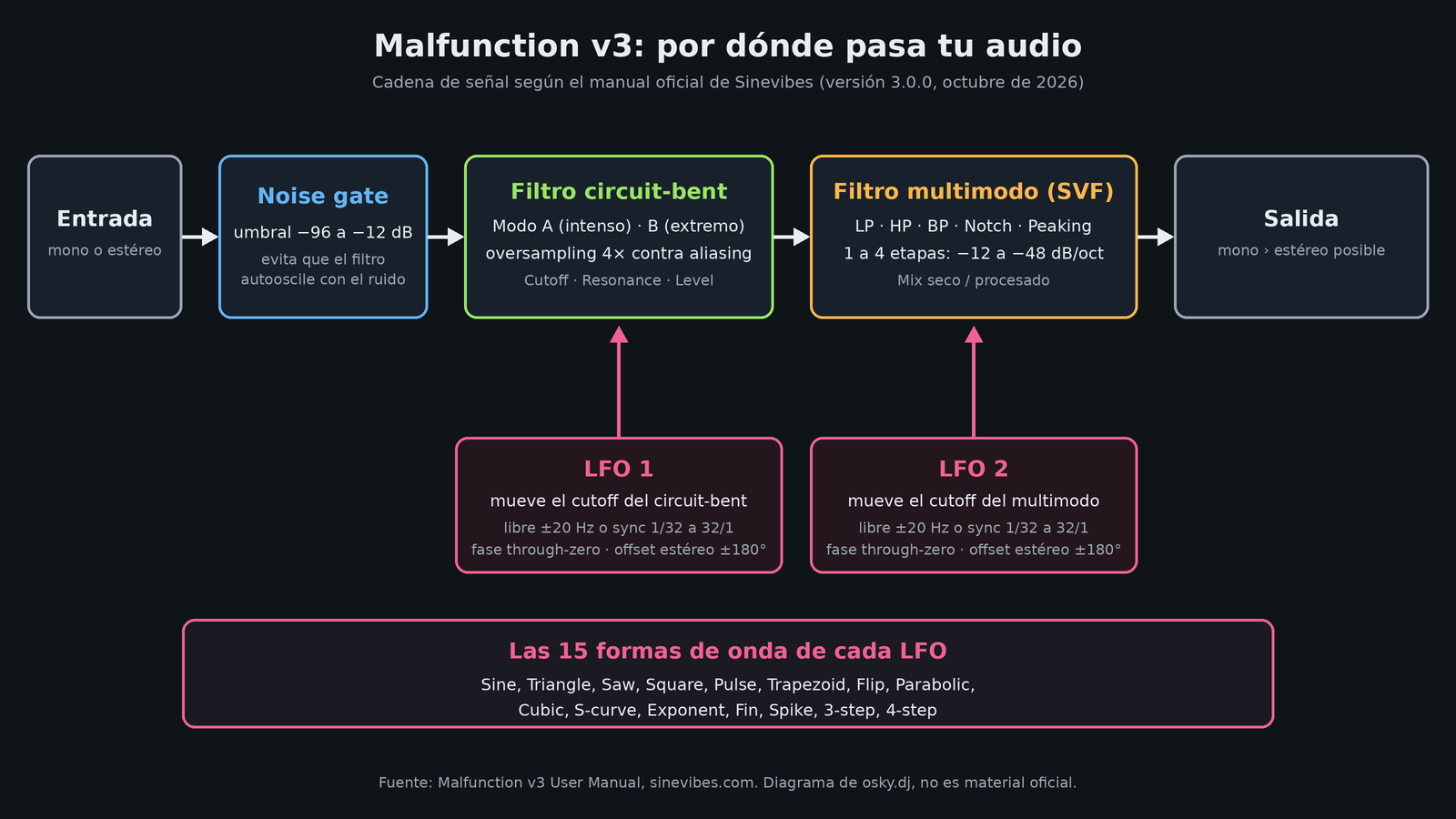
- Input noise gate with an adjustable threshold from −96 to −12 dB. Its job, according to the manual, is to keep the filter from self-oscillating when the signal carries background noise.
- State-variable multimode filter with five modes (low-pass, high-pass, band-pass, notch and peaking) and one to four stages in series, meaning slopes from −12 to −48 dB per octave. The Mix control between dry and processed signal lives here too.
- Two LFOs with through-zero phase, free frequency from −20 to +20 Hz or tempo-synced from 1/32 to 32/1, and stereo phase offset of up to ±180°. The first modulates the cutoff of the circuit-bent filter; the second, the cutoff of the multimode filter.
- 15 waveforms per LFO: Sine, Triangle, Saw, Square, Pulse, Trapezoid, Flip, Parabolic, Cubic, S-curve, Exponent, Fin, Spike, 3-step and 4-step.
- Lag filters on all continuous parameters, so you can move knobs without clicks.
- Mono › mono, mono › stereo and stereo › stereo routing, a vector interface scalable from 0.8× to 2×, and built-in preset management.
Formats, price and requirements
| Platform | Formats | Minimum requirement |
|---|---|---|
| macOS | AU, VST3, AAX | macOS 10.13, Apple Silicon and 64-bit Intel |
| Windows | VST3, AAX | Windows 8.1, 64-bit Intel and AMD |
| Linux | VST3 | "Linux 2020 or newer," 64-bit Intel and AMD |
The price is $29 and it's sold on the Sinevibes site; there's also a downloadable demo version. The brand's updates page lists build 3.0.0 dated October 29, 2026. The previous version, Malfunction 2, appears there with its last build, 2.0.2, from May 2022.
What I couldn't find in the official sources: whether v2 owners get a free or discounted upgrade. Sinevibes doesn't say so on the plugin page or in the announcement. If you own v2, the Updates page asks for your purchase email to send you the available versions; that's what I'd check first.
How it sounds, according to someone who did hear it
Sinevibes published three official demos, and their descriptions tell you well what was run through the filter: an acid line with the AudioRealism ABL3 synth and six factory presets, a TR-909 kick with six presets, and an electro break with an Elektron Analog Four mkII and five presets.
Peter Kirn of CDM also tried it and recorded a video. His impression is that B mode has a very different character, with meatier lows, and he describes it as a processor that can go from "degrading" to generating precise, brutal glitches. That's CDM's opinion, not a manufacturer claim.
My take: why a DJ or producer would want it
My read is that the combo that matters here is B mode + synced LFO + Mix. A distorting filter is something you already have in any DAW; one that moves in rhythmic patterns at tempo, with 15 different shapes and stereo offset, is good for something very specific in techno and tech house: taking a percussion loop or an acid bass line that's already boring and turning it into a variation for the break, without touching the original pattern. With Mix you can run it in parallel so the hit stays there and the chaos lives on top.
The input noise gate isn't a minor detail either. A filter like this, with high resonance, starts self-oscillating on the background noise of a recording or an analog synth. Having the gate built in saves you from weird plugin chains.
And a practical point for anyone working on Linux: there's a native VST3, which still isn't standard among commercial plugins. For people producing in Bitwig or Reaper on Linux, it's one more option with no Wine in between.
If you have KORG hardware
Malfunction doesn't live only on the computer. On September 6, 2026, Sinevibes released a version of Malfunction as a plugin for KORG's prologue, minilogue xd, NTS-1, NTS-1 mkII, NTS-3 and microKORG2. It's a separate product from the desktop v3; if your setup is hybrid, it's worth checking both pages.