Music ·
Living Sky: MNTRA turns your GPU into a 3D spatial mixing and reverb engine
MNTRA Instruments has put Living Sky on sale, a plugin that combines a 3D spatial mixer and a convolution reverb in a single piece, and sends the heavy lifting to your graphics card instead of the processor. It costs $799 and comes with a free 30-day trial. It arrives almost three years after it was first announced, in January 2024, and its promise is clear: stop treating reverb as the last touch-up of the mix and turn space into something you can touch, move, and that responds to sound. For anyone producing, mixing, or designing audio for events and video, it matters for two reasons: immersive mixing keeps gaining ground, and your computer's GPU is almost always on vacation while the CPU is drowning.
What Living Sky is
According to the official MNTRA page, Living Sky is a "spatial and reverb engine" that recreates the resonance of real spaces as very high-resolution 3D sound fields. Under the hood it runs hundreds of convolutions on the GPU in real time, mixing and transforming recorded responses. The idea, in the brand's words, is to have the realism of a captured space together with the movement and modulation of an algorithmic reverb.
It was developed by three teams over three years:
- MNTRA: concept, product design, acoustic research, and captures of the spaces.
- Outer Echo: design and implementation of the spatial audio engine.
- Soundcore, from GPU Audio: the GPU processing.
MNTRA is the tools division of La Hacienda Creative, the studio of composer Brian D'Oliveira, who has made music and sound for Shadow of the Tomb Raider and Resident Evil Village, according to its own site.
The numbers that matter
According to the product page and the launch story in Attack Magazine:
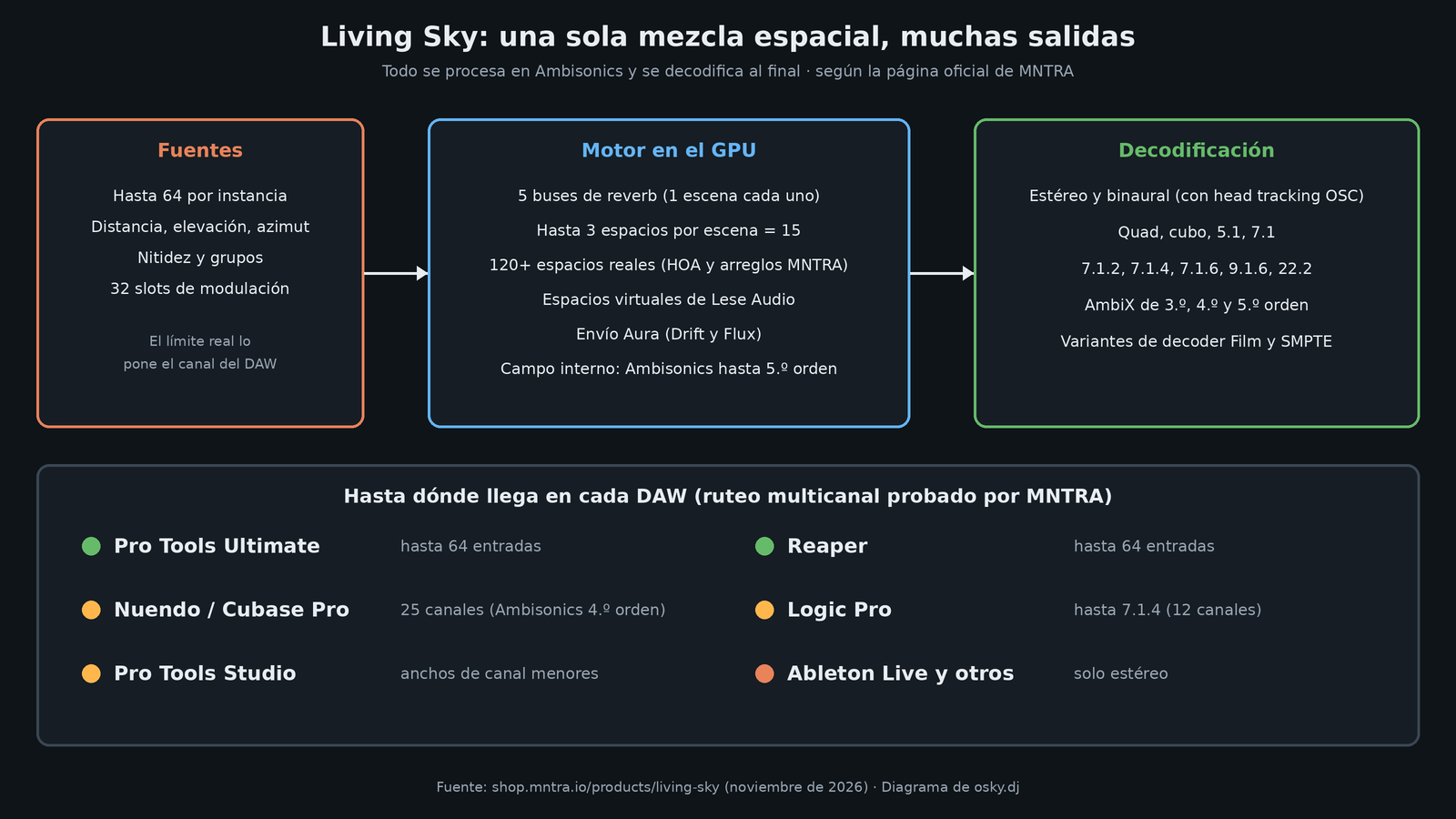
- Up to 64 sources per instance, each with distance, elevation, azimuth, and sharpness control, plus groups to move several together.
- Five reverb buses. Each one loads a "scene" of up to three spaces with its own EQ and size: up to 15 spaces per instance.
- More than 120 spatial responses recorded in real places with higher-order Ambisonics and MNTRA's own microphone arrays, captured from several positions per room. Virtually modeled spaces by Lese Audio are added on top.
- 32 modulation slots and a send called Aura, a parallel reverb that reacts to the position and energy of each source, with Drift (depth) and Flux (speed) knobs.
- A separate 3D control app, linked to the plugin, for viewing and moving sources.
- Head tracking via OSC for binaural monitoring with compatible devices.
A detail that hits close to home: MNTRA says the library already includes captures from Montreal and Mexico City, and that it will keep growing with new spaces.
Mix once, deliver in anything
The underlying trick is that everything is processed in Ambisonics and only decoded at the end. According to MNTRA, that lets you move up or down between formats without remixing or changing how your chosen spaces sound:
- Stereo and binaural.
- Quad, cube, 5.1, 7.1, 7.1.2, 7.1.4, 7.1.6, 9.1.6, and 22.2, with Film and SMPTE decoder variants.
- Export the field directly as 3rd, 4th, or 5th order AmbiX.
Heads up on one detail: to master Dolby Atmos ADM files you still need a Dolby Atmos renderer. Living Sky gives you the spatial mix; it doesn't replace that part of the chain.
The fine print: your DAW calls the shots
Here's what matters most to the electronic music crowd. Living Sky comes in VST3, AU, and AAX, so it opens in almost any DAW, but spatial multichannel routing is only tested in some of them:
| DAW | Spatial reach according to MNTRA |
|---|---|
| Pro Tools Ultimate | Up to 64 inputs |
| Reaper | Up to 64 inputs |
| Nuendo and Cubase Pro | Up to 25 channels (4th-order Ambisonics) |
| Logic Pro | Up to 7.1.4 (12 channels) |
| Pro Tools Studio | Smaller channel widths |
| Ableton Live and others | Stereo only |
In other words: if you produce in Ableton, today you use it as a very sophisticated stereo reverb (with space mixing, modulation, and Aura), not as a 64-source 3D mixer. MNTRA says it is still certifying more DAWs. It also warns that it doesn't guarantee it will work in more than one DAW at a time, and that with the DAW's sandboxing (multiprocess) turned on, multiple instances aren't supported.
Machine requirements
- Mac: Apple silicon from M1 to M5 (no Intel support), macOS 13 to 26, 16 GB of RAM or more.
- Windows: Windows 10 22H2 or 11, 16 GB of RAM, and an NVIDIA GeForce 10 series or newer GPU, or AMD Radeon RX 6800 and up.
- 5 GB of disk space and a sweet spot of 48 kHz: at higher sample rates the load multiplies.
MNTRA clarifies that typical sessions, with 1 to 6 spaces and 1 to 32 sources, run on modern machines, but that pushing it to the max calls for mid-to-high-end production hardware.
Price and trial
The full license costs $799, works on up to three computers belonging to a single person, and, according to MNTRA, is "never" discounted. The 30-day trial is free but limited: 4 sources, stereo and binaural output, and a selection of spaces, for non-commercial evaluation only. The brand asks you to use the trial before buying, because once the license is downloaded the purchase is final, except in cases like duplicate charges or it not working on a supported configuration.
What people who have used it say
Matt Anderson reviewed it in Tape Op after more than a month on Dolby Atmos projects. He says he hesitates to call it a "reverb" because it's "almost a complete system in itself." He highlights the 3D app, which he compares to the Atmos renderer, and how easy it was to bring a 7.0.4 microphone array in as individual sources. His warning: there's a learning curve. On MNTRA's page, Grammy-winning engineer Justin Gray says he has more than 3,000 songs mixed in Atmos and had never heard anything like it. That's a testimonial published by the brand itself, so take it as such.
My take
I haven't tried it; all of this comes from MNTRA's official documentation and the specialist press. That said, Living Sky targets a clear audience: film post, video games, music for Atmos, and immersive installations. At $799 and with Ableton limited to stereo, for the average DJ or techno producer it's a luxury, not a necessity. Where it can hit hard is at events and shows with multi-speaker systems: an Ambisonics field that you decode to the venue's array sounds exactly like what people building immersive experiences are asking for. And it's another sign that the GPU is no longer just for video and AI: real-time audio wants it too.