Music ·
Audient Refreshes Its iD Interfaces with Built-In Monitor Correction: What Changes on the iD1, iD2, iD2+ and iD4+
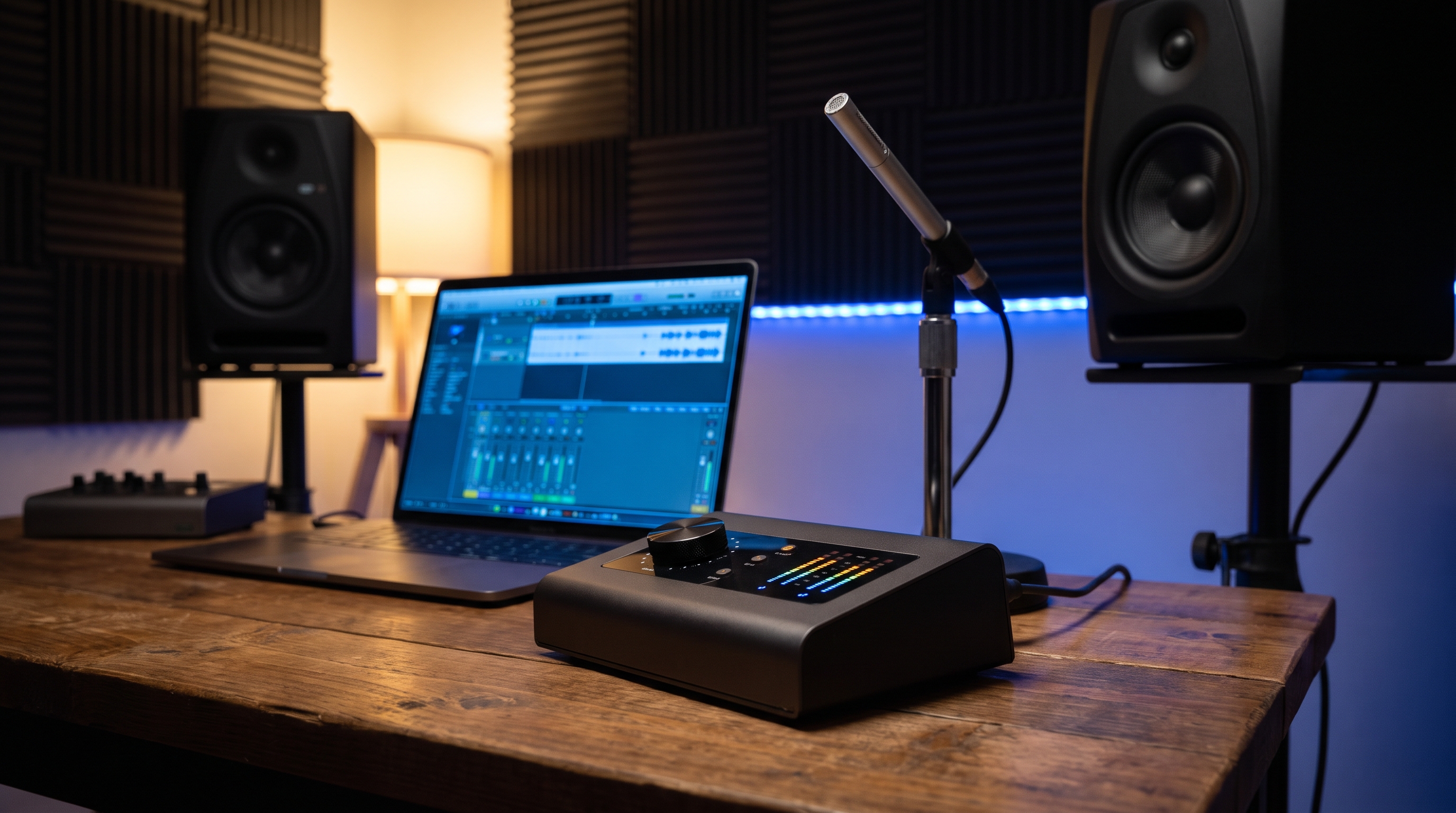
Audient, the British brand that made a name for itself by squeezing console preamps into little desktop boxes, introduced the third generation of its iD range on November 12, 2026. It's four USB-C audio interfaces (iD1, iD2, iD2+ and iD4+) that, besides getting new names, bring something almost nobody offers at this price point: built-in monitor correction, which runs on the interface's own DSP and not on your computer. For anyone producing in a room with no acoustic treatment (in other words, almost everyone producing at home), that's the part that matters. Everything else, from zero-latency DSP effects to analog saturation on the input, is the garnish.
What Audient announced
According to the official announcement, all four interfaces share the same platform, which Audient has dubbed "Analogue Intelligence": analog preamps up front and a DSP behind them that handles levels, room correction and effects. All of them include:
- Audient Console preamps, the same discrete Class A design as their flagship ASP8024-HE console, with 75 dB of clean gain.
- RoomTune, the new monitor correction software, free with every interface.
- Analogue Tone Suite: four tools for adding color to the sound before it reaches the DAW (Orbit, HMX, LIFT and GLOW).
- Hardware-accelerated DSP effects: EQ, compression and reverb with zero latency.
- 32-bit conversion with 128 dB of dynamic range, up to 192 kHz, on Mac and Windows.
- Full USB-C power, no adapter needed, even on the biggest one.
- Smartgain, which sets the input level by itself, and analog settings that can be digitally recalled per session.
Andrew Allen, Audient's product director, summed it up like this: "This isn't a spec refresh", meaning it's not just a spec update, but a brand-new platform.
The new names, explained
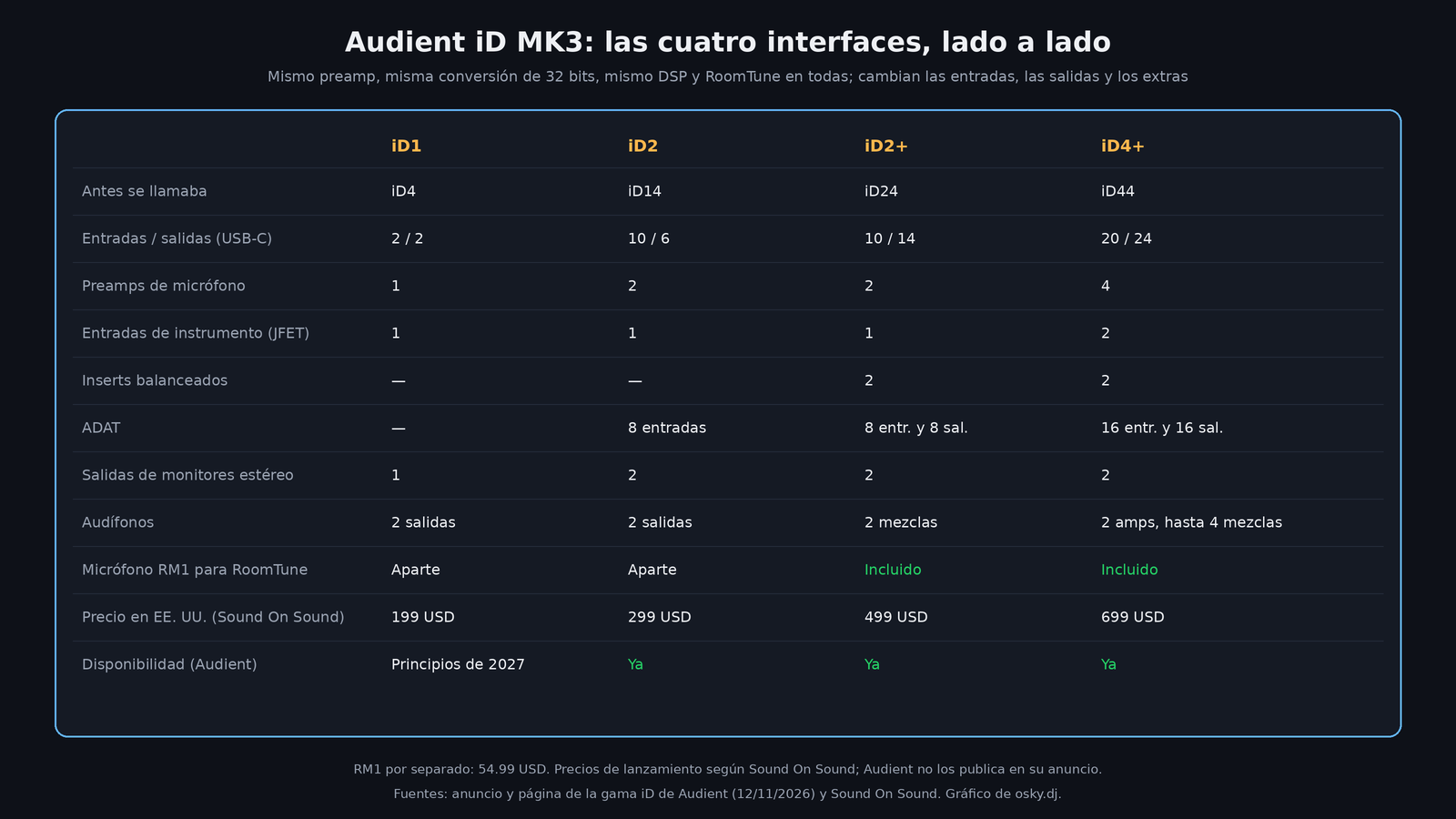
Audient did us a favor here: the old names were a tongue twister (iD4, iD14, iD24, iD44), and now the number tells you how many mic preamps each model has. The "+" marks the models with balanced inserts, ADAT in and out, and fuller monitor control. The equivalents, according to Audient:
- iD1 (formerly iD4): 2 inputs and 2 outputs, one preamp and one JFET instrument input that can be used at the same time.
- iD2 (formerly iD14): 10 inputs and 6 outputs, two preamps, ADAT for eight more inputs and two pairs of monitor outputs.
- iD2+ (formerly iD24): 10 inputs and 14 outputs, two preamps, two balanced inserts and 8-channel ADAT in and out.
- iD4+ (formerly iD44): 20 inputs and 24 outputs, four preamps, two instrument inputs, two inserts, 16-channel ADAT and two independent headphone amps with up to four mixes.
RoomTune: correction that lives in the interface
Until now, correcting your monitors' response at home almost always meant buying separate software and loading a plugin on the DAW's master bus, with the classic risk of forgetting to remove it when you export. Audient solves it differently: RoomTune runs on the interface's DSP, so according to the brand it uses no CPU and the calibration applies to the whole system, from the DAW to Spotify.
The details worth reading before you swipe your card:
- You need the RM1 microphone. It comes included with the iD2+ and iD4+; for the iD1 and iD2 it's sold separately (USD 54.99, according to Sound On Sound).
- For now it only corrects the stereo monitor outputs. Headphone correction and more target profiles will arrive, according to Audient, in a future free update, with no date given.
- It stores up to 32 room profiles, according to the iD2+ page, and switches on its own between the main and alternate monitors when you press ALT.
My take: room correction doesn't replace acoustic treatment. A bass null caused by the room's geometry can't be fixed with EQ, and no serious manufacturer says otherwise. But for the producer mixing in a bedroom with parallel walls, having it inside the interface, with no extra plugin and no forgetting it on the master bus, is a practical change.
The fine print
- The iD1 isn't out yet. Audient says the iD2, iD2+ and iD4+ are already available, and that the iD1 will arrive in early 2027. Sound On Sound lists it as available; here the primary source rules.
- The DSP effects have a sample rate cap. The iD2+ FAQ clarifies that per-channel EQ and compression in iD Control work at sample rates up to 96 kHz. If you record at 192 kHz, count on not having them.
- Prices. Audient's announcement doesn't include them. According to Sound On Sound, in the United States they are: iD1, USD 199; iD2, USD 299; iD2+, USD 499; iD4+, USD 699. The brand hasn't published prices for Mexico yet; with import costs and taxes, expect them to be higher.
- Compatibility. According to Audient, macOS 12 or later, Windows 10 and 11, and iPad or iPhone with no drivers. I haven't tested it: all of this comes from Audient's official documentation.
What this means for people producing at home
For a DJ who produces their own tracks, the interesting model is probably the iD2: two preamps, two pairs of monitors and RoomTune for USD 299, plus the RM1 sold separately. Anyone who already has a hardware compressor or EQ they want to use while recording should look at the iD2+, which brings the inserts and the mic in the box. The iD4+ is for people who record bands or drums, or who need to send different mixes to several musicians.
If you already have an iD14 or an iD24 that works, the honest question is whether you'd pay for another interface for the room correction and DSP effects. The preamps, according to Audient itself, are the same design as always. The real leap is in what's behind them.